GUJCET Electrochemistry — practice questions
115 free MCQs with worked solutions. Tap any question for the answer + explanation, or practice them all in the app.
Practice GUJCET Electrochemistry in the app →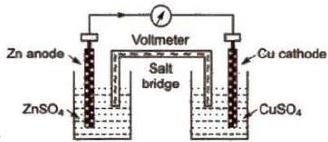
In the Daniell cell shown, which metal acts asFor a galvanic cell, the standard cell EMF is given by:Given standard reduction potentials $E^{\circ}(\mathrm{Cu^{2+}/Cu}) = +0.34$ V and $E^{\circ}(\mathrm{Zn^{2+}/The Nernst equation for a half-cell reaction at 298 K is:How many coulombs of charge are required to deposit $108$ g of silver from a $\mathrm{AgNO_3}$ solution? (AtomWhen a current of $5$ A is passed through a $\mathrm{CuSO_4}$ solution for $193$ seconds, the mass of Cu deposA substance whose aqueous solution conducts electricity by dissociation into ions is called a(n):The SI unit of electrical conductance is:**Conductivity** $\kappa$ of a solution refers to:**Molar conductivity** $\Lambda$ is defined as:**Kohlrausch's law** of independent migration of ions states that at infinite dilution:On dilution, the **conductivity** ($\kappa$) of an electrolyte solution:On dilution, the **molar conductivity** ($\Lambda$) of an electrolyte:The **degree of dissociation** $\alpha$ of a weak electrolyte is related to its molar conductivity by:**Cell constant** of a conductivity cell is given by:For a **strong** electrolyte (e.g. KCl), the variation of molar conductivity $\Lambda$ with $ qrt{c}$ is:The molar conductivity of 0.05 M BaCl₂ solution at 25 °C is 223 Ω⁻¹ cm² mol⁻¹. Its conductivity ($\kappa$) is:Using Kohlrausch's law, if $\Lambda_0$(NaI) = 126.9, $\Lambda_0$(AgNO₃) = 133.4, $\Lambda_0$(NaNO₃) = 121.5 (aGiven molar ionic conductivities $\lambda^0$: Ca²⁺ = 104, Cl⁻ = 76.4 (Ω⁻¹ cm² mol⁻¹), the molar conductivity aThe molar conductivity of 0.01 M acetic acid is 16.5 Ω⁻¹ cm² mol⁻¹, and $\Lambda_0$ = 390.7 Ω⁻¹ cm² mol⁻¹. TheA conductivity cell containing 0.01 M KCl ($\kappa = 0.00141$ Ω⁻¹ cm⁻¹) at 25 °C has resistance 604 Ω. The celFor weak electrolytes, why is $\Lambda_0$ determined indirectly (via Kohlrausch's law from strong electrolyte In a galvanic cell, the **anode** is the electrode at which:In a galvanic cell, current in the external circuit flows from:The Gibbs free-energy change of a galvanic cell reaction is given by:For a cell with $E^0 = 1.10$ V and $n = 2$ electrons transferred, the standard Gibbs energy change $\Delta G^0Which of the following is the correct **decreasing order** of standard reduction potential (i.e. from strongesA salt bridge in a galvanic cell:A conductivity cell has cell constant 0.852 cm⁻¹. Filled with 0.001 M AgNO₃ solution, it shows resistance 6530For 0.01 M acetic acid at 25 °C, $\Lambda_c = 16.5$ Ω⁻¹ cm² mol⁻¹ and $\Lambda_0 = 390.7$ Ω⁻¹ cm² mol⁻¹. The dThe molar conductivities of HCl, CH₃COONa, and NaCl at infinite dilution are 426.1, 91.0 and 126.4 Ω⁻¹ cm² molFor the cell Zn|Zn²⁺‖Cu²⁺|Cu with $E^0_{cell} = 1.10$ V, the equilibrium constant $K$ at 298 K ($n=2$, RT/F = The **Nernst equation** for a half-cell reaction (M^n+ + n e⁻ → M) at 298 K can be written as:A current of 2 A is passed through molten CuCl₂ for 30 minutes. The mass of copper deposited at the cathode isFor a galvanic cell, $\Delta G^0$ of the cell reaction is −58 kJ/mol, with $n = 2$ electrons transferred. The Two electrolytic cells, one with AgNO₃ and another with CuSO₄, are connected in **series** and the same currenIn a galvanic cell, the oxidation half-reaction takes place at the:In the standard Daniell cell (Zn|Zn²⁺ || Cu²⁺|Cu) at unit concentrations, the cell EMF is: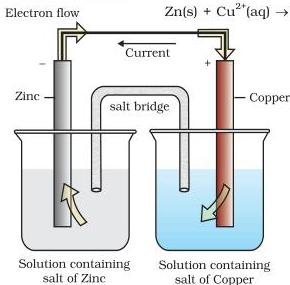
If an external opposinThe standard hydrogen electrode (SHE) is assigned a standard electrode potential of:In the standard electrode potential series, F₂/F⁻ has E° = +2.87 V and Li⁺/Li has E° = −3.05 V. Which of the fThe Nernst equation for the cell reaction aA + bB → cC + dD at 298 K is:For the cell Zn | Zn²⁺ || Cu²⁺ | Cu at 298 K, the Nernst equation expresses E_cell as:For the cell Cu(s) + 2Ag⁺ → Cu²⁺ + 2Ag, E°_cell = +0.46 V at 298 K. The equilibrium constant K_c is approximatThe relation between cell EMF and Gibbs free-energy change is:ΔG is an extensive property while E_cell is an intensive property. This means:The SI unit of conductance (G = 1/R) is:The relation between conductivity κ, cell constant (l/A), and conductance G is:The molar conductivity Λ_m of an electrolyte solution is defined as:As an electrolyte solution is diluted, the **conductivity (κ)** and **molar conductivity (Λ_m)** respectively: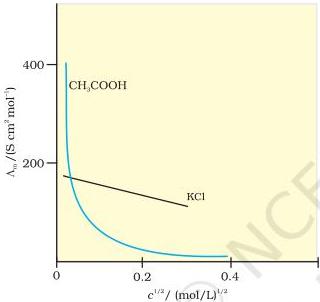
For *stKohlrausch's law of independent migration of ions states that the limiting molar conductivity of an electrolytGiven λ°(Ca²⁺) = 119.0 and λ°(Cl⁻) = 76.3 S cm² mol⁻¹, the limiting molar conductivity of CaCl₂ is:Given Λ°_m for HCl, NaAc, NaCl = 425.9, 91.0, 126.4 S cm² mol⁻¹ respectively. Calculate Λ°_m for acetic acid (For a weak electrolyte at concentration c, the degree of dissociation α can be approximated as:The molar conductivity of 0.001028 M acetic acid is 48.15 S cm² mol⁻¹, and Λ°_m(HAc) = 390.5 S cm² mol⁻¹. The Faraday's first law of electrolysis states that the mass of substance deposited at an electrode is proportionaThe Faraday constant F = 96500 C mol⁻¹ represents:A CuSO₄ solution is electrolysed with 1.5 A for 10 minutes. The mass of copper (M = 63.5) deposited at the catIn the electrolysis of **molten** NaCl, the products at the cathode and anode respectively are:During electrolysis of **aqueous** NaCl (brine), the products are: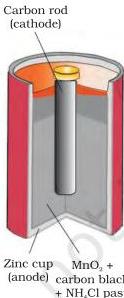
In a Leclanche (dry) cell,The electrolyte in a lead storage battery (lead-acid) is approximately:In the H₂–O₂ fuel cell used in the Apollo space programme, the electrolyte is:Rusting of iron is an electrochemical phenomenon. At the cathodic spot, the reaction is:Rust is chemically:Why does corrosion of iron require both water and oxygen?A device converting CHEMICAL energy to electrical energy via spontaneous redox is a:In the Daniell cell, the cathode reaction is:EMF of standard Daniell cell at 25°C is approximately:Faraday's first law of electrolysis states mass deposited is proportional to:The value of Faraday's constant F is approximately:In a galvanic cell, electrons flow externally from:The Nernst equation gives cell EMF at non-standard conditions. For a half-cell Mⁿ⁺ + ne⁻ → M, it is:Relation between standard cell potential E°, ΔG°, and equilibrium constant K:For ΔG° < 0 (spontaneous), E° must be:The molar conductivity Λ_m of an electrolyte:Kohlrausch's law states the limiting molar conductivity of an electrolyte is:For the cell Zn | Zn²⁺ (1 M) || Cu²⁺ (1 M) | Cu, with E°(Zn) = -0.76 V, E°(Cu) = +0.34 V, E_cell:Standard electrode potential of SHE (Standard Hydrogen Electrode) is taken as:For Cu²⁺ + 2e⁻ → Cu, how much charge to deposit 0.5 mol Cu? (F = 96500 C/mol)Conductivity κ of pure water is approximately:At 25°C, ratio of Nernst factor 0.0591/n to RT/(nF) ln 10 in SI units:A current of 2 A flows for 30 min through a CuSO4 solution. Mass of Cu deposited (M_Cu = 63.5):For the cell: Zn|Zn²⁺(0.1 M)||Cu²⁺(0.01 M)|Cu, at 25°C, E_cell is:Equilibrium constant K of the Daniell cell at 25°C (E° = 1.10 V, n = 2):A 0.1 M weak acid HA has Λ_m = 10 S·cm²/mol; at infinite dilution Λ_m^0 = 400. Degree of dissociation α:In electrolysis of CuSO4 with Pt electrodes, the cathode product is:Standard electrode potentials: E°(Fe³⁺/Fe²⁺) = +0.77 V, E°(I2/I⁻) = +0.54 V. For the reaction 2Fe³⁺ + 2I⁻ → 2FWhy is the cell potential temperature-dependent?For Hg²⁺/Hg (E° = +0.79 V) and Cu²⁺/Cu (E° = +0.34 V), the spontaneous reaction is:Conductivity of a 0.01 M NaCl solution is 0.0014 S/cm. Molar conductivity Λ_m:Lead-acid battery during DISCHARGE: PbO2 + Pb + 2H2SO4 → 2PbSO4 + 2H2O. The role of PbO2 is:Corrosion of iron involves which type of reaction?In electroplating silver onto a spoon, the cathode is:Electrochemistry deals with:In a galvanic (voltaic) cell, oxidation occurs at:Standard electrode potential of standard hydrogen electrode (SHE) is:In Daniell cell (Zn | Zn²⁺ || Cu²⁺ | Cu), electron flow in external circuit:Faraday's first law of electrolysis: amount of substance liberated at electrode is proportional to:Conductance is the:Nernst equation for cell potential (at 25°C):For Daniell cell, cell reaction Zn + Cu²⁺ → Zn²⁺ + Cu. Cell EMF:Faraday constant F is:Standard Gibbs free energy and cell EMF relation:Relation between equilibrium constant K and E°:How many coulombs are needed to deposit 1 mole of Cu from CuSO₄ (Cu²⁺ + 2e⁻ → Cu)?Time to deposit 1.27 g of Cu from CuSO₄ solution at 2 A current (Cu atomic mass = 63.5):Equilibrium constant for cell with E° = 0.118 V, n = 2, at 25°C:Specific conductance κ has units:Hydrogen-Oxygen fuel cell produces:Lead acid battery (used in cars) overall reaction:Standard reduction potential ranking. Which is the strongest oxidizing agent?Resistance of a conductivity cell filled with 0.1 M KCl is 100 Ω. Specific conductivity κ of solution (cell coFor a cell reaction reversed in direction, E° becomes: