JEE Main Wave Optics — practice questions
107 free MCQs with worked solutions. Tap any question for the answer + explanation, or practice them all in the app.
Practice JEE Main Wave Optics in the app →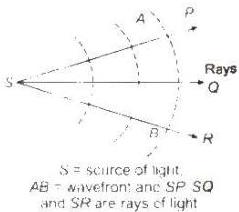
According to Huygens' principle, every poinTwo light sources can produce sustained interference fringes on a screen only if they are:In Young's double-slit experiment, fringe width $\beta = \dfrac{\lambda D}{d}$. If the screen distance $D$ is In Young's double-slit experiment, monochromatic light of wavelength $600$ nm is used. The slit separation is 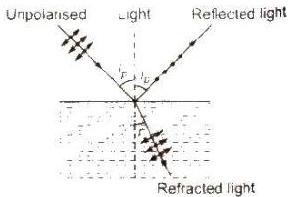
Unpolarised light strikes a glass surface aMonochromatic light of wavelength $\lambda$ passes through a single slit of width $a$. The angular position $\Snell's law states that the ratio sin(i)/sin(r) for two media is:The wavefront from a point source is:Young's double-slit experiment demonstrates which phenomenon?Two waves with the same frequency and constant phase difference are called:In Young's double-slit experiment, the bright fringe condition is path difference equals:Polarization of light is possible because light is:In Young's experiment, fringe width β equals:In Young's experiment with d = 1 mm, D = 1 m, light wavelength 600 nm, fringe width is:When light goes from a less dense to denser medium (e.g., air to water), it bends:Critical angle for total internal reflection from water (n = 4/3) to air:In a thin film of thickness t with refractive index n, condition for destructive interference for reflected liDiffraction is the:Single-slit diffraction first minimum occurs at angle θ where:Brewster's angle θ_B for light hitting glass (n = 1.5) from air satisfies:Why don't we see interference between two different light bulbs?For maximum brightness in Newton's rings (reflected light, air film), what is the radius of n-th bright ring? Two slits 0.5 mm apart with light of wavelength 5000 Å. The 5th bright fringe is at distance from central maxiIn Young's experiment, if the entire setup is immersed in water (n = 4/3), the fringe width:Power of a convex lens of focal length 50 cm:Resolution limit of a telescope by Rayleigh criterion:Wavelength of light in water (n = 4/3) if its vacuum wavelength is 600 nm:Two coherent sources have intensities I1 = 9I and I2 = I. Maximum and minimum intensities in interference pattIn Young's experiment, intensity at a point where path difference is λ/4:For a grating with 500 lines/mm and light at 600 nm, find angle for the first-order maximum:In single-slit diffraction, ratio of intensities of first and central maxima is approximately:Speed of light in a medium of refractive index 1.5 is:For a thin film (refractive index 1.4, thickness 250 nm), which visible wavelength shows constructive interferFor a thin film (e.g., soap bubble) of refractive index 1.4 and thickness 250 nm, what wavelengths in visible In a meter bridge experiment, when wavelength changes from 600 nm to 400 nm, the fringe width:A wavefront is:Young's double-slit experiment demonstrates:For constructive interference, path difference Δp =In YDSE, fringe width β =Coherent sources have:In YDSE with λ = 600 nm, d = 0.2 mm, D = 1 m, fringe width =Diffraction is:Single-slit diffraction first minimum at angle θ satisfies:Polarization establishes that light is:Brewster's law: angle of polarization i_B from glass-air interface satisfies:Maximum number of bright fringes visible in YDSE with d/λ = 4:Speed of light in a medium of refractive index n =Resolving power of a microscope is proportional to:In YDSE with monochromatic light (λ = 500 nm) and d = 0.1 mm, distance from central maximum to 3rd bright frinIn YDSE, when whole apparatus is immersed in water (n = 4/3), fringe width:Intensity at point in YDSE with phase difference φ between two waves of equal amplitude:For single-slit diffraction of width a, angular position of m-th minimum:Resolving power of diffraction grating with N lines:Width of central maximum in single-slit diffraction:Light from a sodium lamp (λ = 590 nm) falls on YDSE with d = 0.5 mm, screen D = 1 m. Fringe width:Two slits separated by d emit light of wavelength λ. Angular separation of fringes:Resolving power of telescope is given by Rayleigh criterion:In Young's double slit, $\lambda = 600$ nm, slit separation $d = 0.5$ mm, screen distance $D = 1$ m. Fringe wiIn single-slit diffraction with $\lambda = 500$ nm and slit width $a = 0.1$ mm, the angular position of the fiPolaroid sunglasses reduce glare from a wet road most effectively because:Light passes from air to glass ($n = 1.5$). Brewster's angle is:HUYGENS' PRINCIPLE states that every point on a wavefront acts as a:For two light sources to produce STABLE INTERFERENCE FRINGES, they must be:In Young's double-slit experiment, the fringe width β is given by:In Young's experiment, a BRIGHT fringe (constructive interference) requires path difference = ?In single-slit diffraction, the central maximum is:Polarisation of light is direct experimental evidence that light is a:BREWSTER'S LAW for the polarising angle θ_B relates to the refractive index n as:By Malus's law, if plane-polarised light of intensity I_0 passes through a polariser oriented at 60° to the poThe resolving power (RP) of a diffraction grating with N slits in the m-th order is:In Young's double-slit experiment, the fringe width β is given byIn a double-slit experiment, if the wavelength is doubled and the slit separation is halved, the fringe width At a point where the path difference between two coherent light waves is 3λ/2, the interference isThe principle of superposition of waves states that at a pointThe Huygens principle states that every point of a wavefront acts asTwo coherent sources produce interference fringes. If the intensities of individual sources are I₁ = 4I₀ and IFor diffraction at a single slit of width a, the angular position of the first minimum is given byThe width of the central maximum in single-slit diffraction on a screen at distance D isThe polarising angle (Brewster angle) for glass of refractive index 1.5 isWhich of the following phenomena is characteristic ONLY of transverse waves and NOT of longitudinal waves?An unpolarised light of intensity I₀ passes through a polariser. The transmitted intensity isIf polarised light of intensity I passes through a polariser whose axis makes angle θ with the polarisation diCoherent sources are those that emit waves ofIn a Young's double-slit experiment, a thin transparent sheet of thickness t and refractive index n is placed Newton originally supported the corpuscular theory of light. The wave theory was strongly established byThe corpuscular model of light was given in 1637 by:The corpuscular model is often attributed to Newton for his book:The wave theory of light was put forward in 1678 by:The speed of light in water was shown to be less than in air by:Foucault carried out that measurement in the year:The famous interference experiment of 1801 was performed by:Light was shown to be an electromagnetic wave by:Light waves are electromagnetic waves that are:A surface of constant phase in a wave is called a:Wave energy travels in a direction to the wavefront that is:The wavefronts from a point source are:Far from the source, a small part of the wavefront is nearly:Each point of a wavefront acts as a source of a:The next position of a wavefront is found by drawing a common:Huygens explained the missing backwave by taking the amplitude zero:Two sources whose phase difference does not change are:Coherent sources give an interference pattern that is:Two separate light sources lighting one wall are:When two sources are incoherent, their intensities:The increase in wavelength from the Doppler effect is called:Light with no preferred direction of vibration is:A polaroid is made of long chain molecules that are: