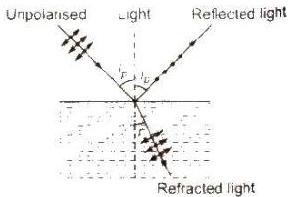
 Unpolarised light strikes a glass surface at Brewster's angle ($\mu = \tan i_p$). The reflected light is:
APlane-polarised parallel to the plane of incidence
BPlane-polarised perpendicular to the plane of incidence
CUnpolarised
DElliptically polarised
Answer & Solution
Correct answer: B. Plane-polarised perpendicular to the plane of incidence
At Brewster's angle the reflected and refracted rays are perpendicular to each other. Light polarised in the plane of incidence (the electric vector parallel to that plane) is not reflected at all because the radiating dipoles in the medium are oriented exactly along the direction the reflected ray would have to travel. So the only component that survives in the reflected ray is the one perpendicular to the plane of incidence.
Result: reflected light at Brewster's angle is completely plane-polarised, with vibration perpendicular to the plane of incidence. The refracted ray contains both components and is therefore only partially polarised.
Related questions
Blue sky seen through a rotating polaroid rises and falls in brightness. Sky light is:Two polaroids are set crossed. The light passing through both is:Ordinary lamp light passes through one polaroid. Its intensity drops to:Wiggle a string up and down and a wave runs along it. The displacement is at right angles The rainbow of colours you see on a CD comes from:Diffraction is shown by:Near the edge of a shadow you see alternate dark and bright bands. This is:In Young's pattern, consecutive bright fringes are: