JEE Main Electrochemical Series — practice questions
120 free MCQs with worked solutions. Tap any question for the answer + explanation, or practice them all in the app.
Practice JEE Main Electrochemical Series in the app →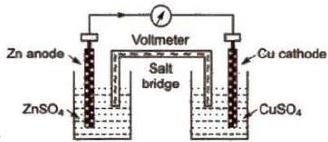
In the Daniell cell shown, which metal acts asFor a galvanic cell, the standard cell EMF is given by:Given standard reduction potentials $E^{\circ}(\mathrm{Cu^{2+}/Cu}) = +0.34$ V and $E^{\circ}(\mathrm{Zn^{2+}/The Nernst equation for a half-cell reaction at 298 K is:How many coulombs of charge are required to deposit $108$ g of silver from a $\mathrm{AgNO_3}$ solution? (AtomWhen a current of $5$ A is passed through a $\mathrm{CuSO_4}$ solution for $193$ seconds, the mass of Cu deposA device converting CHEMICAL energy to electrical energy via spontaneous redox is a:In the Daniell cell, the cathode reaction is:EMF of standard Daniell cell at 25°C is approximately:Faraday's first law of electrolysis states mass deposited is proportional to:The value of Faraday's constant F is approximately:In a galvanic cell, electrons flow externally from:The Nernst equation gives cell EMF at non-standard conditions. For a half-cell Mⁿ⁺ + ne⁻ → M, it is:Relation between standard cell potential E°, ΔG°, and equilibrium constant K:For ΔG° < 0 (spontaneous), E° must be:The molar conductivity Λ_m of an electrolyte:Kohlrausch's law states the limiting molar conductivity of an electrolyte is:For the cell Zn | Zn²⁺ (1 M) || Cu²⁺ (1 M) | Cu, with E°(Zn) = -0.76 V, E°(Cu) = +0.34 V, E_cell:Standard electrode potential of SHE (Standard Hydrogen Electrode) is taken as:For Cu²⁺ + 2e⁻ → Cu, how much charge to deposit 0.5 mol Cu? (F = 96500 C/mol)Conductivity κ of pure water is approximately:At 25°C, ratio of Nernst factor 0.0591/n to RT/(nF) ln 10 in SI units:A current of 2 A flows for 30 min through a CuSO4 solution. Mass of Cu deposited (M_Cu = 63.5):For the cell: Zn|Zn²⁺(0.1 M)||Cu²⁺(0.01 M)|Cu, at 25°C, E_cell is:Equilibrium constant K of the Daniell cell at 25°C (E° = 1.10 V, n = 2):A 0.1 M weak acid HA has Λ_m = 10 S·cm²/mol; at infinite dilution Λ_m^0 = 400. Degree of dissociation α:In electrolysis of CuSO4 with Pt electrodes, the cathode product is:Standard electrode potentials: E°(Fe³⁺/Fe²⁺) = +0.77 V, E°(I2/I⁻) = +0.54 V. For the reaction 2Fe³⁺ + 2I⁻ → 2FWhy is the cell potential temperature-dependent?For Hg²⁺/Hg (E° = +0.79 V) and Cu²⁺/Cu (E° = +0.34 V), the spontaneous reaction is:Conductivity of a 0.01 M NaCl solution is 0.0014 S/cm. Molar conductivity Λ_m:Lead-acid battery during DISCHARGE: PbO2 + Pb + 2H2SO4 → 2PbSO4 + 2H2O. The role of PbO2 is:Corrosion of iron involves which type of reaction?In electroplating silver onto a spoon, the cathode is:Electrochemistry deals with:In a galvanic (voltaic) cell, oxidation occurs at:Standard electrode potential of standard hydrogen electrode (SHE) is:In Daniell cell (Zn | Zn²⁺ || Cu²⁺ | Cu), electron flow in external circuit:Faraday's first law of electrolysis: amount of substance liberated at electrode is proportional to:Conductance is the:Nernst equation for cell potential (at 25°C):For Daniell cell, cell reaction Zn + Cu²⁺ → Zn²⁺ + Cu. Cell EMF:Faraday constant F is:Standard Gibbs free energy and cell EMF relation:Relation between equilibrium constant K and E°:How many coulombs are needed to deposit 1 mole of Cu from CuSO₄ (Cu²⁺ + 2e⁻ → Cu)?Time to deposit 1.27 g of Cu from CuSO₄ solution at 2 A current (Cu atomic mass = 63.5):Equilibrium constant for cell with E° = 0.118 V, n = 2, at 25°C:Specific conductance κ has units:Hydrogen-Oxygen fuel cell produces:Lead acid battery (used in cars) overall reaction:Standard reduction potential ranking. Which is the strongest oxidizing agent?Resistance of a conductivity cell filled with 0.1 M KCl is 100 Ω. Specific conductivity κ of solution (cell coFor a cell reaction reversed in direction, E° becomes:Per NCERT §7.1 (classical), the term OXIDATION (broadened) covers which of the following changes?Per NCERT §7.2, in modern (electron-transfer) terms, OXIDATION is defined as which process?Per NCERT §7.2, an OXIDISING AGENT is best described as which kind of species?Per NCERT §7.2 eqn 7.14, in the reaction 2Na(s) + S(s) → Na₂S(s), which species is OXIDISED?Per NCERT §7.2.1, in Zn(s) + Cu²⁺(aq) → Zn²⁺(aq) + Cu(s), which acts as the reducing agent?Per NCERT §7.2.1, the electron-releasing (reducing) tendency among the metals Zn, Cu, Ag is in which order?Per NCERT §7.1, oxidation can also be characterised as the addition of which kind of element to a substance?Per NCERT §7.1 eqn 7.4, in 2H₂S(g) + O₂(g) → 2S(s) + 2H₂O(l), H₂S is oxidised mainly because of which change?Per NCERT §7.2, a HALF REACTION is best characterised as which kind of equation?Per NCERT Problem 7.2, in 2Na(s) + H₂(g) → 2NaH(s), the role of hydrogen is which?Per NCERT §7.2.1, when Cu(s) is placed in AgNO₃(aq), the equilibrium of Cu + 2Ag⁺ → Cu²⁺ + 2Ag favours which sPer NCERT §7.2.1, when Co(s) is placed in NiSO₄(aq), which describes the position of the resulting equilibriumPer NCERT §7.3 (rule 3), the oxidation number of oxygen in a normal PEROXIDE (e.g. H₂O₂, Na₂O₂) is which?Per NCERT §7.3 (rule 3), the oxidation number of oxygen in a SUPEROXIDE (e.g. KO₂, RbO₂) is which?Per NCERT §7.3 (rule 3), the oxidation number of oxygen in OF₂ (oxygen difluoride) is which?Per NCERT §7.3 (rule 4), the oxidation number of hydrogen in a binary metal HYDRIDE (e.g. NaH, LiH, CaH₂) is wPer NCERT §7.3 (rule 1), the oxidation number of an atom in any element in its FREE / UNCOMBINED form (e.g. O₂Per NCERT §7.3 rules, the oxidation number of sulphur in H₂SO₄ is which?Per NCERT §7.3 rules, the oxidation number of chromium in K₂Cr₂O₇ is which?Per NCERT §7.3 rules, the oxidation number of Mn in KMnO₄ is which?Per NCERT §7.3 Problem 7.3 (Stock notation), the iron in Fe₂O₃ is best written with which Roman numeral?Per NCERT §7.3 (Stock notation), MnO₂ is best written as which formula?Per NCERT §7.3 (highest oxidation states), the highest oxidation state of chlorine in its compounds (e.g. HClOPer NCERT §7.3 (fractional ox. numbers box), the AVERAGE oxidation number of S in S₄O₆²⁻ (tetrathionate) is whPer NCERT §7.3.1, a COMBINATION reaction is classified as redox under which condition?Per NCERT §7.3.1, the decomposition CaCO₃(s) → CaO(s) + CO₂(g) is classified as which kind of reaction?Per NCERT §7.3.1(3), the reaction CuSO₄(aq) + Zn(s) → ZnSO₄(aq) + Cu(s) is classified as which type?Per NCERT §7.3.1(3a) eqn 7.32, the reaction Cr₂O₃(s) + 2 Al(s) → Al₂O₃(s) + 2 Cr(s) is an example of which indPer NCERT §7.3.1(3b), the OXIDISING strength among halogens decreases in which order?Per NCERT §7.3.1(3b), the reaction Cl₂(g) + 2 KI(aq) → 2 KCl(aq) + I₂(s) is an example of which kind?Per NCERT §7.3.1(4), a DISPROPORTIONATION reaction is best described as which kind?Per NCERT eqn 7.45, in 2H₂O₂(aq) → 2H₂O(l) + O₂(g), the oxidation states of O in H₂O₂, O₂, and H₂O are which sPer NCERT eqn 7.48, Cl₂(g) + 2 OH⁻ → ClO⁻ + Cl⁻ + H₂O has Cl in which oxidation states in products?Per NCERT §7.3.1(4), which halogen does NOT undergo disproportionation with alkali (unlike Cl₂, Br₂, I₂)?Per NCERT Problem 7.5, among the chlorine oxoanions ClO⁻, ClO₂⁻, ClO₃⁻, ClO₄⁻, which one does NOT disproportioPer NCERT §7.3.1(3b) eqn 7.40, the reaction 2 H₂O + 2 F₂ → 4 HF + O₂ shows which species being oxidised?Per NCERT §7.3.2, the TWO methods used to balance redox reactions are which?Per NCERT Problem 7.8, the balanced ionic equation for Cr₂O₇²⁻ + SO₃²⁻ → Cr³⁺ + SO₄²⁻ in acid solution uses hoPer NCERT Problem 7.8, the same Cr₂O₇²⁻ + SO₃²⁻ balanced equation produces how many H₂O molecules on the produPer NCERT §7.3.2 (half-reaction method), Step 4 for an ACIDIC medium adds which species?Per NCERT eqn 7.54, the balanced reduction half-reaction for Cr₂O₇²⁻ in acidic medium consumes how many H⁺?Per NCERT eqn 7.54, the balanced reduction half-reaction for Cr₂O₇²⁻ in acidic medium gains how many electronsPer NCERT §7.3.2 (half-reaction method) for a BASIC medium, oxygen balance is achieved by adding which speciesPer NCERT Problem 7.9, the balanced reaction of MnO₄⁻ with Br⁻ in BASIC medium gives MnO₂ and which Br speciesPer NCERT §7.3 (definitions revised), OXIDATION in terms of oxidation number means which change?Per NCERT Problem 7.4, in 2Cu₂O(s) + Cu₂S(s) → 6Cu(s) + SO₂(g), which species is REDUCED?Per NCERT Problem 7.6, the reaction N₂(g) + O₂(g) → 2 NO(g) is classified as which type of redox?Per NCERT Problem 7.6, the reaction 2 NO₂(g) + 2 OH⁻ → NO₂⁻ + NO₃⁻ + H₂O is classified as which type?In a Daniell cell with Zn (anode) and Cu (cathode), and $E^\circ(Cu^{2+}/Cu) = +0.34$ V, $E^\circ(Zn^{2+}/Zn) The Nernst equation at $25^\circ$C for a cell with $n$ electrons transferred is $E = E^\circ -$:Electrolysis of molten NaCl at the electrode passes $1$ F of charge. The amount of Na deposited at the cathodeIron rusting on the village ploughshare is best described as:In a GALVANIC cell, the ANODE is:The standard electrode potential of the Standard Hydrogen Electrode (SHE) is defined as:The Daniell cell (Zn-Cu) has E°cell = +1.10 V. Calculate ΔG° (F = 96500 C/mol):The Nernst equation at 25°C for a cell reaction is:Kohlrausch's law is most useful for determining the LIMITING molar conductivity (Λ°m) of:Faraday's first law of electrolysis states that the mass deposited is:A typical LEAD STORAGE BATTERY (car battery) used in vehicles consists of 6 cells in series, each producing abThe byproduct of a hydrogen-oxygen fuel cell (used in space + electric cars) is:GALVANISATION protects iron from rusting by coating it with:The standard EMF of a Zn|Zn²⁺||Cu²⁺|Cu cell (E°_Cu²⁺/Cu = +0.34 V; E°_Zn²⁺/Zn = −0.76 V) isThe Nernst equation for a cell reaction at 298 K is E_cell = E°_cell − (0.059/n) log Q. Here n isFor the reaction Cu²⁺ + 2e⁻ → Cu with E° = +0.34 V, what is the cell potential when [Cu²⁺] = 0.01 M at 298 K?One Faraday equals the charge onThe mass of copper deposited when a current of 5.0 A flows for 30 minutes through a solution of CuSO₄ (M_Cu =