JEE Main Solutions — practice questions
101 free MCQs with worked solutions. Tap any question for the answer + explanation, or practice them all in the app.
Practice JEE Main Solutions in the app →For gases only, the molecular weight is given in the notes byAccording to the given formula list, formality is defined for an ionic solute asIf a solute has valency factor $x$, then normality $N$ is related to molarity $M$ byWhich relation for millimoles is correct?According to the listed formulas, the strength of a solution can be expressed asWhich expression correctly gives the molarity of a solution?Which statement correctly describes Raoult's law for an ideal solution of two volatile liquids A and B?Colligative properties of a dilute solution depend on: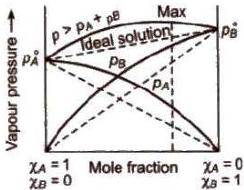
The figure shows a non-ideal solution with *The molal boiling-point elevation constant of water is $K_b = 0.52$ K kg/mol. What is the boiling point of a s$36$ g of glucose ($M = 180$ g/mol) is dissolved in $200$ g of water. The molality of the solution is:The van't Hoff factor $i$ for a $0.01$ M aqueous solution of NaCl, assuming complete dissociation, is approximHenry's law for the solubility of a gas in a liquid is best stated as:Why are deep-sea divers given a breathing mixture of helium and oxygen instead of ordinary air?The mole fraction of urea ($M = 60\,\text{g/mol}$) in an aqueous solution containing $6\,\text{g}$ of urea in For an ideal solution containing two volatile liquids A and B, Raoult's law gives the total vapour pressure asFor a dilute solution of a non-volatile solute B in a solvent A, the relative lowering of vapour pressure equaThe elevation in boiling point of a solution is given by $\Delta T_b = K_b m$. The molal elevation constant $KThe freezing point of water is depressed when a non-volatile solute is added because:Osmotic pressure of a dilute solution is expressed by van't Hoff's equation as:Two solutions are said to be **isotonic** if they:If $\mathrm{NaCl}$ undergoes complete dissociation in water, the van't Hoff factor $i$ is:Benzoic acid associates in benzene to form dimers. The van't Hoff factor $i$ for benzoic acid in benzene (assuDesalination of sea water is best carried out by:A solution of glucose in water has a freezing point depression of $0.186\,\text{K}$. Given $K_f$ for water $= A solution showing positive deviation from Raoult's law has:Molarity M is defined as:Molality m is defined as:Mole fraction x_A is:Raoult's law for an ideal solution (one component A in solvent S) is:Henry's law for gas dissolution: solubility of a gas (mass m_gas per unit mass of solvent) is:Colligative properties depend on:What is the molarity of a solution containing 5.85 g of NaCl (M.W. = 58.5) in 250 mL of solution?Boiling point elevation: ΔT_b = K_b × m. For 1 molal aqueous urea (K_b = 0.52 K kg/mol), ΔT_b equals:Freezing point depression: ΔT_f = K_f × m. For 0.5 molal NaCl (assume full dissociation, K_f = 1.86), the deprVapour pressure of pure water at 25°C is 23.8 mm Hg. The vapour pressure of a solution with 18 g glucose (M.W.Osmotic pressure π = nRT/V (or CRT for molarity C). What is π for 0.1 M sugar solution at 27°C (R = 0.0821)?The van't Hoff factor i for a strong electrolyte like CaCl2 (full dissociation) is:In ideal solutions, ΔH_mix is:Mass percentage (w/w) of a solution: 12 g sugar in 100 g of solution is:Two solutions are isotonic if:For an azeotrope of HCl and water (boiling at 110°C with 20.2% HCl by mass), the composition and boiling pointMaximum boiling azeotropes are formed by mixtures with:Molality of a solution does not depend on:For 0.5 m solutions of NaCl, KCl, and BaCl2, which gives largest ΔT_f?Pure water boils at 100°C; pure ethanol at 78°C. A 0.5 mole fraction mixture under positive deviation will:Osmotic pressure of 0.1 M Glucose at 27°C is π_g. For 0.1 M NaCl at same T, the osmotic pressure is approximatThe pKa of a weak acid HA is 4.75. Find pH of an equimolar mixture of HA and A⁻:Solubility of N2 in water at 25°C is 6.8 × 10⁻⁴ mol/L at 1 atm partial pressure. By Henry's law, at 5 atm partTwo solutions A (0.1 M urea, π_A) and B (0.1 M NaCl, π_B). Water flows by osmosis:A solution boils at 100.5°C (water at 100). If K_b = 0.52, molality is:Mole fraction of solute in 18% glucose (180 g/mol) by mass in water:Vapour pressure of pure water is 100 (arbitrary units). Add 1 mole non-volatile solute to 9 moles water. New vA solution is:Mole fraction of solute x_B in a binary solution:Molarity M is defined as:Molality m is defined as:Henry's law states partial pressure of a gas above liquid is proportional to:Raoult's law for ideal solution states vapor pressure of solvent:For dilute solutions, lowering of vapor pressure of solvent ΔP / P°_A =Elevation in boiling point ΔT_b for solution of non-volatile solute:Depression in freezing point ΔT_f for non-electrolyte solute:Osmotic pressure π for dilute solution:For NaCl in water (assumes complete dissociation), van't Hoff factor i =For 0.1 M urea in water, freezing point depression (K_f = 1.86):Mass percent of solute = (mass of solute / mass of solution) × 100. For 5 g NaCl in 95 g water:Two volatile liquids A (P°_A = 100) and B (P°_B = 200) form ideal solution. For x_A = 0.4, total vapor pressurOsmotic pressure of 0.01 M sucrose solution at 27°C (R = 0.0821 L atm/mol K):For solution of urea (M_w = 60 g/mol) with 6 g in 100 g water, molality:For 0.1 M acetic acid (Ka = 1.8 × 10⁻⁵), van't Hoff factor i is:For salt CaCl₂ (assume full dissociation), i =For a 1 m glucose aqueous solution (i = 1), boiling point:Freezing-point depression and elevation are colligative properties: depend on:The solubility of a gas in a liquid generally:A $0.5$ molal aqueous solution of a non-electrolyte ($K_b = 0.52$ K kg/mol for water) boils at:A solution of $0.1$ M sucrose at $300$ K has osmotic pressure (using $R = 0.0821$ L atm/(mol K)):The van't Hoff factor $i$ for $0.1$ m NaCl (assuming complete dissociation) is:The MOLARITY of a solution containing 58.5 g NaCl dissolved in 1 L of solution is:The KEY DIFFERENCE between molarity (M) and molality (m) is that:HENRY'S LAW states that at constant temperature:A MINIMUM-BOILING azeotrope arises from:Which of these is NOT a colligative property?Salt is sprinkled on icy roads in cold countries to:The OSMOTIC PRESSURE π of a dilute solution is given by:The van't Hoff factor (i) for sodium chloride (NaCl) in water is approximately:Raoult's law for an ideal solution of two volatile components states:The mole fraction of ethylene glycol in a 20 % (w/w) aqueous solution (molar masses: glycol 62, water 18) is c5 g of NaOH (molar mass 40 g/mol) is dissolved in 450 mL solution. The molarity is closest toWhich of the following concentration units of a solution is temperature-dependent?Molality of a solution containing 2.5 g of ethanoic acid (CH₃COOH, M = 60 g/mol) in 75 g of benzene is closestHenry law states that the partial pressure of a gas in solution isFor a solution of a non-volatile solute, Raoult law implies that the vapour pressure of the pure solventFor an ideal binary liquid solution, Raoult law gives the total vapour pressure asWhich of the following is NOT a colligative property?If a solute dimerises in solution, its observed molar mass compared with the calculated value will beA negative deviation from Raoult law is expected whenVan't Hoff factor i > 1 for a solute indicatesOsmotic pressure π of a dilute solution obeys π = C R T. Here C representsThe molality of a 1 M aqueous NaCl solution (density = 1.04 g/mL, NaCl M = 58.5 g/mol) is closest toWhich of these solutions will boil at the highest temperature at 1 atm?The mass of NaOH (M = 40 g/mol) required to prepare 500 mL of a 0.20 M NaOH solution is