NEET UG Electrochemistry — practice questions
59 free MCQs with worked solutions. Tap any question for the answer + explanation, or practice them all in the app.
Practice NEET UG Electrochemistry in the app →In a galvanic cell, the oxidation half-reaction takes place at the:In the standard Daniell cell (Zn|Zn²⁺ || Cu²⁺|Cu) at unit concentrations, the cell EMF is: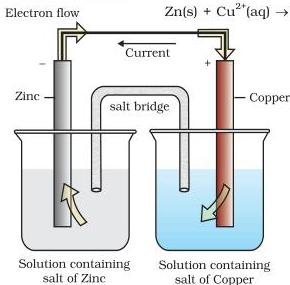
If an external opposinThe standard hydrogen electrode (SHE) is assigned a standard electrode potential of:In the standard electrode potential series, F₂/F⁻ has E° = +2.87 V and Li⁺/Li has E° = −3.05 V. Which of the fThe Nernst equation for the cell reaction aA + bB → cC + dD at 298 K is:For the cell Zn | Zn²⁺ || Cu²⁺ | Cu at 298 K, the Nernst equation expresses E_cell as:For the cell Cu(s) + 2Ag⁺ → Cu²⁺ + 2Ag, E°_cell = +0.46 V at 298 K. The equilibrium constant K_c is approximatThe relation between cell EMF and Gibbs free-energy change is:ΔG is an extensive property while E_cell is an intensive property. This means:The SI unit of conductance (G = 1/R) is:The relation between conductivity κ, cell constant (l/A), and conductance G is:The molar conductivity Λ_m of an electrolyte solution is defined as:As an electrolyte solution is diluted, the **conductivity (κ)** and **molar conductivity (Λ_m)** respectively: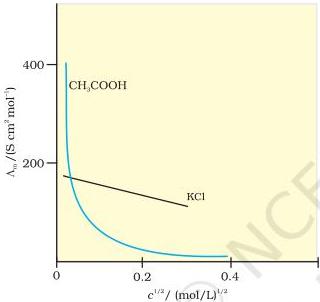
For *stKohlrausch's law of independent migration of ions states that the limiting molar conductivity of an electrolytGiven λ°(Ca²⁺) = 119.0 and λ°(Cl⁻) = 76.3 S cm² mol⁻¹, the limiting molar conductivity of CaCl₂ is:Given Λ°_m for HCl, NaAc, NaCl = 425.9, 91.0, 126.4 S cm² mol⁻¹ respectively. Calculate Λ°_m for acetic acid (For a weak electrolyte at concentration c, the degree of dissociation α can be approximated as:The molar conductivity of 0.001028 M acetic acid is 48.15 S cm² mol⁻¹, and Λ°_m(HAc) = 390.5 S cm² mol⁻¹. The Faraday's first law of electrolysis states that the mass of substance deposited at an electrode is proportionaThe Faraday constant F = 96500 C mol⁻¹ represents:A CuSO₄ solution is electrolysed with 1.5 A for 10 minutes. The mass of copper (M = 63.5) deposited at the catIn the electrolysis of **molten** NaCl, the products at the cathode and anode respectively are:During electrolysis of **aqueous** NaCl (brine), the products are: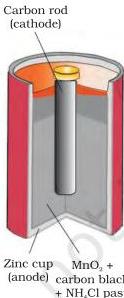
In a Leclanche (dry) cell,The electrolyte in a lead storage battery (lead-acid) is approximately:In the H₂–O₂ fuel cell used in the Apollo space programme, the electrolyte is:Rusting of iron is an electrochemical phenomenon. At the cathodic spot, the reaction is:Rust is chemically:Why does corrosion of iron require both water and oxygen?In a Daniell cell with Zn (anode) and Cu (cathode), and $E^\circ(Cu^{2+}/Cu) = +0.34$ V, $E^\circ(Zn^{2+}/Zn) The Nernst equation at $25^\circ$C for a cell with $n$ electrons transferred is $E = E^\circ -$:Electrolysis of molten NaCl at the electrode passes $1$ F of charge. The amount of Na deposited at the cathodeIron rusting on the village ploughshare is best described as:In a GALVANIC cell, the ANODE is:The standard electrode potential of the Standard Hydrogen Electrode (SHE) is defined as:The Daniell cell (Zn-Cu) has E°cell = +1.10 V. Calculate ΔG° (F = 96500 C/mol):The Nernst equation at 25°C for a cell reaction is:Kohlrausch's law is most useful for determining the LIMITING molar conductivity (Λ°m) of:Faraday's first law of electrolysis states that the mass deposited is:A typical LEAD STORAGE BATTERY (car battery) used in vehicles consists of 6 cells in series, each producing abThe byproduct of a hydrogen-oxygen fuel cell (used in space + electric cars) is:GALVANISATION protects iron from rusting by coating it with:The standard EMF of a Zn|Zn²⁺||Cu²⁺|Cu cell (E°_Cu²⁺/Cu = +0.34 V; E°_Zn²⁺/Zn = −0.76 V) isThe Nernst equation for a cell reaction at 298 K is E_cell = E°_cell − (0.059/n) log Q. Here n isFor the reaction Cu²⁺ + 2e⁻ → Cu with E° = +0.34 V, what is the cell potential when [Cu²⁺] = 0.01 M at 298 K?One Faraday equals the charge onThe mass of copper deposited when a current of 5.0 A flows for 30 minutes through a solution of CuSO₄ (M_Cu = Kohlrausch's law of independent migration of ions is used to computeFor a Cu-Zn Daniell cell, the emf is measured to be 1.10 V under standard conditions. If [Cu²⁺] = 1 M and [Zn²Molar conductivity of a strong electrolyte at concentration c is related to its limiting value Λ°_m by the DebThe specific conductivity of a 0.1 M KCl solution is 1.29 × 10⁻² S/cm. The molar conductivity isFuel cells directly convertRusting of iron requires which two chemicals in contact with the metal?The primary cell that cannot be reused after its EMF drops to zero is exemplified byThe overall cell reaction of the lead storage battery on discharge isWhich of the following statements about electrode potentials is INCORRECT?For an electrochemical cell operating spontaneously, ΔG° is related to E°_cell by