AMUEEE Current Electricity — practice questions
96 free MCQs with worked solutions. Tap any question for the answer + explanation, or practice them all in the app.
Practice AMUEEE Current Electricity in the app →Ohm's law states that, for an ohmic conductor at constant temperature:
Three resistors of $2\,\Omega$, $4\,\Omega$ an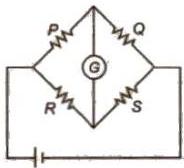
In the Wheatstone bridge shown above, $P = 4\,Three identical resistors, each of resistance $R$, are connected in **parallel**. The equivalent resistance is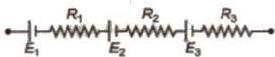
$n$ identical cells, each of EMF $E$ and interA $10$-m-long potentiometer wire of uniform resistance is connected to a $6$-V battery (and no other resistancKirchhoff's **junction (current) law** states that, at any junction in an electrical network:Kirchhoff's **voltage (loop) law** in any closed loop of an electrical network states:The balance condition for a Wheatstone bridge with arms $P, Q, R, S$ (galvanometer between B and D) is:In an electrical network, a **junction** is defined as:In an electrical network, a **loop** (mesh) is:Kirchhoff's first law (junction law) is a consequence of:Kirchhoff's second law (voltage/loop law) is a consequence of:The **potential gradient** $K$ along a uniform potentiometer wire is defined as:While applying Kirchhoff's first law, currents **arriving** at the junction are considered:An **ideal voltmeter** measuring a potential difference should have:Five conductors meet at a junction P (see figure). Currents $I_1 = 2$ A and $I_3 = 5$ A flow **into** the juncThree resistors of values 2 Ω, 3 Ω and 6 Ω are connected in parallel between two nodes. The equivalent resistaIn a metre-bridge experiment, a known resistance $R = 5\ \Omega$ is in the right gap. The balance length on thTwo cells are compared using a potentiometer. The null lengths are $\ell_1 = 360$ cm for cell 1 and $\ell_2 = In Kelvin's method for galvanometer resistance using a metre bridge, the balance length opposite the galvanomeIn a Post Office Box (a Wheatstone-bridge variant), if the ratio arms have $P = 100\ \Omega$, $Q = 10\ \Omega$A potentiometer wire of length 4 m has a potential gradient $K = 0.5$ V/m. The EMF of a cell that balances at While tracing a loop **in the direction of current** through a resistor, the potential difference across that An emf source is traversed from its negative to positive terminal while tracing a loop. The EMF contribution tIn a metre bridge experiment, the null point should ideally be obtained in the middle one-third (between 34 cmWheatstone bridge is typically used to measure resistances in the range:A potentiometer compares the EMFs of two cells. Cell 1 with $\varepsilon_1 = 1.5$ V gives a null length 75 cm.Two batteries of EMF 7 V (internal resistance 1 Ω) and 13 V (internal resistance 2 Ω) are connected in paralleFor a balanced Wheatstone bridge with $P = 1.36\ k\Omega$, $R = 300\ \Omega$ and $S = 4.4\ k\Omega$, the unknoIn a metre bridge with $X = 2\ \Omega$ in the left gap and $R = 3\ \Omega$ in the right gap, the wire (length The specific resistance ρ of a metre-bridge wire of length 1 m, diameter 0.12 cm and resistance 1.49 Ω is apprIn a network with cells of negligible internal resistance, applying Kirchhoff's laws gives the equations $4I_1For a Wheatstone bridge at balance, the bridge is **insensitive** to changes in the galvanometer's internal reA potentiometer wire of length 10 m carries a steady current. EMF $\varepsilon_1$ balances at 6 m; the same ceTwo cells of EMF $\varepsilon_1$ and $\varepsilon_2$ ($\varepsilon_1 > \varepsilon_2$) connected so that **likThe SI unit of electric current is:The current I is related to charge q and time t by:Electric current is a:Ohm's law states V = ___ ?The SI unit of resistance is:For resistors in series, the equivalent resistance is:For resistors in PARALLEL, the equivalent resistance is given by:Kirchhoff's Current Law (KCL) is based on conservation of:Kirchhoff's Voltage Law (KVL) is based on conservation of:A galvanometer can be CONVERTED to an ammeter by:Find the equivalent resistance of 2 Ω and 3 Ω connected in SERIES:Find the equivalent resistance of 6 Ω and 3 Ω in PARALLEL:A battery with emf 12 V and internal resistance 1 Ω drives 2 A current. Find terminal voltage V:Resistance R of a conductor is proportional to:Two resistors 4 Ω and 12 Ω are in parallel; this combination is in series with 8 Ω. Total resistance:Drift velocity v_d is given by:In a Wheatstone bridge, BALANCE condition gives:A 2 Ω, 4 Ω and 6 Ω resistor are in parallel. Equivalent resistance:To convert a galvanometer to a VOLTMETER, connect:Three cells of emf 2 V each, internal resistance 0.5 Ω each, are connected in series. Total emf and internal rThree identical cells with emf 1.5V and internal resistance 0.6 Ω each are connected in parallel. Find equivalIf a wire of resistance R is cut into 4 equal parts and joined in parallel, the new resistance is:A potentiometer is a NULL device used to:A 10 V battery is connected across a 5 Ω resistor. The current through the resistor is:Specific resistivity (ρ) of a conductor depends mainly on:An ammeter has 0.1 Ω resistance and 1 mA full-scale current. The shunt needed to extend range to 1 A:In a Wheatstone bridge: P = 4Ω, Q = 8Ω, R = 6Ω. For balance, S =Five identical bulbs are connected in series across an emf of 100V. Each bulb has resistance 5 Ω. Find total cA 12V battery (internal r = 0.5 Ω) drives current through 5.5 Ω external load. Find power dissipated in EXTERNA copper wire of length 1 m and cross-section 1 mm² has resistivity 1.7 × 10⁻⁸ Ω·m. Its resistance is:Two batteries with emf E₁ = 4V (r₁ = 1Ω) and E₂ = 6V (r₂ = 2Ω) in parallel. Find equivalent emf:A wire of resistance 10 Ω is stretched to double its length without changing volume. Its new resistance:In a circuit, drift velocity of electrons is 10⁻⁴ m/s. Number density of free electrons is 10²⁹ /m³. Charge peMaximum power transfer from a source occurs when external resistance equals:In a meter bridge experiment, the null point divides the wire as 30 cm and 70 cm. If known resistance is 6 Ω, A resistor carries a current of 2 A when a potential difference of 10 V is applied across it. Its resistance iThe SI unit of current density is:For a uniform wire of resistance R = ρl/A, the resistivity ρ depends on:When an electric field E is applied along a metallic conductor, the conduction electrons acquire a drift velocThe power dissipated in a resistor of resistance R carrying a steady current I is:The emf of a cell is equal to the potential difference across its terminals when:Three resistors of 2 Ω, 3 Ω and 5 Ω are connected in series. The equivalent resistance is:Two 6 Ω resistors are connected in parallel. Their equivalent resistance is:A cell of emf 2 V and internal resistance 0.1 Ω is connected across a 3.9 Ω resistor. The current in the circuA cell of emf 2 V and internal resistance 0.1 Ω drives a current of 0.5 A. Its terminal potential difference iIn a metallic wire of fixed n and area A, if the current is doubled, the electron drift speed:A wire is stretched to twice its original length while keeping its volume constant. Its new resistance is:Two bulbs rated 100 W and 60 W are designed for the same supply voltage. Compared with the 60 W bulb, the 100 A platinum resistance thermometer reads 5.00 Ω at 0°C and 5.23 Ω at 100°C. When its resistance is 5.795 Ω, theThe heat produced in a 5 Ω resistor carrying a steady current of 2 A for 10 s is:Estimate the drift speed of electrons in a copper wire carrying 1.5 A with cross-section 1.0×10⁻⁷ m² and n = 8A nichrome heating element has resistance 75.3 Ω at 27°C. On a 230 V supply it settles to a steady current of Two cells, each of emf 1.5 V and internal resistance 0.5 Ω, are connected in series across a 2 Ω resistor. TheTwo identical cells, each of emf 1.5 V and internal resistance 0.5 Ω, are connected in parallel across a 1 Ω rThe maximum current that can be drawn from a cell of emf 1.5 V and internal resistance 0.3 Ω is:Power loss in transmission cables of resistance Rc delivering power P at voltage V is P²Rc/V². To minimise thiAt a junction, currents of 3 A and 5 A flow in, and 2 A flows out through one branch. By Kirchhoff's junction A Wheatstone bridge is balanced with arms P = 10 Ω, Q = 20 Ω and R = 15 Ω. The unknown resistance S is:A 3 Ω resistor is connected in series with a parallel combination of a 6 Ω and a 3 Ω resistor. The equivalent When the temperature of a metallic conductor rises, its resistivity increases mainly because: