Five conductors meet at a junction P (see figure). Currents $I_1 = 2$ A and $I_3 = 5$ A flow **into** the junction, while $I_2 = 3$ A and $I_5 = 2$ A flow **out**. The current $I_4$ (direction: out of the junction) is: 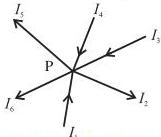
A2 A
B5 A
C1 A
D3 A
Answer & Solution
Correct answer: A. 2 A
KCL at P: arriving = leaving ⇒ $I_1 + I_3 = I_2 + I_4 + I_5$ ⇒ $2 + 5 = 3 + I_4 + 2$ ⇒ $I_4 = 2$ A.
Related questions
The reactance of a capacitor $C$ at frequency $f$ in an a.c. circuit is:A bird perched on a single high voltage wire is unharmed because:The two conservation laws embodied in Kirchhoff's rules are conservation of:The resistance offered by the cell itself is called:Which device detects the current in a Wheatstone bridge?In a Wheatstone bridge, the source is connected across the:The Wheatstone bridge is made up of how many resistors?At a junction, the current entering equals the current: