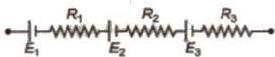
 $n$ identical cells, each of EMF $E$ and internal resistance $r$, are connected **in series** with an external resistance $R$. What is the current $I$ in the circuit?
A$I = \dfrac{nE}{R}$
B$I = \dfrac{nE}{R + nr}$
C$I = \dfrac{E}{R + r}$
D$I = \dfrac{nE}{R + r}$
Answer & Solution
Correct answer: B. $I = \dfrac{nE}{R + nr}$
**Equivalent EMF** of $n$ cells in series = $nE$ (EMFs add).
**Equivalent internal resistance** of the series stack = $nr$ (resistances add in series).
Total circuit resistance = $R + nr$. By Ohm's law applied to the loop:
$$I = \dfrac{nE}{R + nr}$$
**Distractor logic.** Option A ignores internal resistance entirely (would only hold if $r = 0$). Option D forgets to multiply $r$ by $n$ — a single $r$ in the denominator. Option C handles only one cell.
Related questions
The reactance of a capacitor $C$ at frequency $f$ in an a.c. circuit is:A bird perched on a single high voltage wire is unharmed because:The two conservation laws embodied in Kirchhoff's rules are conservation of:The resistance offered by the cell itself is called:Which device detects the current in a Wheatstone bridge?In a Wheatstone bridge, the source is connected across the:The Wheatstone bridge is made up of how many resistors?At a junction, the current entering equals the current: