NEET UG d- and f-Block Elements — practice questions
60 free MCQs with worked solutions. Tap any question for the answer + explanation, or practice them all in the app.
Practice NEET UG d- and f-Block Elements in the app →The general outer electronic configuration of d-block elements is:The electronic configuration of Cr (Z = 24) is:Why are Zn, Cd and Hg not regarded as transition elements?The melting points of transition metals rise to a maximum at d⁵ configuration. This is because:Why is the enthalpy of atomisation of Zn (126 kJ/mol) the lowest in the 3d series?The 2nd and 3rd transition series (4d and 5d) have very similar atomic radii because of:Which 3d transition element exhibits the largest number of oxidation states?The most stable oxidation state of Sc is:E° values for Mn³⁺/Mn²⁺ (+1.57 V), Co³⁺/Co²⁺ (+1.97 V) and Fe³⁺/Fe²⁺ (+0.77 V). Which is the strongest oxidisiThe spin-only magnetic moment μ in BM for n unpaired electrons is given by:Calculate the spin-only magnetic moment of a divalent ion of Mn (Z = 25):Which of the following ions is colourless and diamagnetic?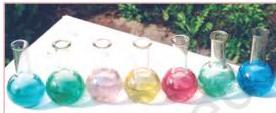
Transition metal ionInterstitial compounds (e.g., TiC, Fe₃H, VH₀.₅₆) of transition metals have:The oxidation state of chromium in both CrO₄²⁻ and Cr₂O₇²⁻ is:In acidic solution, dichromate ion (Cr₂O₇²⁻) acts as a strong oxidising agent. The half-reaction is:Potassium dichromate (K₂Cr₂O₇) is prepared from which ore?In KMnO₄, the oxidation state of Mn is:Disproportionation occurs when:The most common oxidation state of lanthanoids is:Lanthanoid contraction is the:A major consequence of lanthanoid contraction is:Which lanthanoid is well known to exhibit the +4 oxidation state in aqueous solution as a strong oxidising ageActinoids in general have which characteristic that distinguishes them from lanthanoids?The general electronic configuration of actinoids is:Which of the following ions is NOT coloured in aqueous solution?All transition metal ions form complexes more readily than main-group metal ions. Which is the LEAST importantAmong Sc²⁺, V³⁺, Mn²⁺ and Zn²⁺, which is paramagnetic with **5** unpaired electrons?Per NCERT §3.2 + Table 3.3, Mendeleev predicted the existence of 'Eka-aluminium' and 'Eka-silicon' — which latPer NCERT §3.6.5, which elements bordering the metal/non-metal staircase are called METALLOIDS (semi-metals)?Per NCERT §3.6, which exceptional element is positioned in the s-block (1s¹) but is sometimes placed with haloPer NCERT Table 3.7, which element has the MOST NEGATIVE electron gain enthalpy and why is it NOT fluorine?The modern periodic law arranges elements in order of:Ethylenediamine (en) is best described as a:In an octahedral complex like $[Co(NH_3)_6]^{3+}$, the coordination number of cobalt is:The complex $[Pt(NH_3)_2Cl_2]$ (square planar) shows:In crystal field theory, the d-orbitals of an octahedral metal complex split into:In Werner's theory of coordination compounds, the PRIMARY valency corresponds to:The coordination number 6 most commonly gives which geometry?The IUPAC name of K3[Fe(CN)6] is:The drug CISPLATIN has the formula [Pt(NH3)2Cl2]. Its anti-cancer activity comes from the:In Valence Bond Theory, an octahedral LOW-SPIN complex like [Co(NH3)6]³⁺ uses which hybridisation?In Crystal Field Theory, the 5 d-orbitals in an OCTAHEDRAL field split into:In the spectrochemical series, which ligand is the STRONGEST field?The unusual stability of EDTA-metal complexes is mainly due to the:The biological molecule HAEMOGLOBIN contains which metal at its centre?A COORDINATION COMPOUND consists of a central metal atom (or ion) BONDED to a set of surrounding molecules or The COORDINATION NUMBER of the central metal in a complex isA ligand that has ONLY ONE donor atom (which forms a single bond to the central metal) is calledIn the complex $[\mathrm{Co(NH_3)_5\,Cl}]\mathrm{Cl_2}$, the oxidation state of cobalt isETHYLENEDIAMINETETRAACETATE (EDTA) is a famous polydentate ligand. It isThe IUPAC name of $[\mathrm{Co(NH_3)_6}]^{3+}$ isIn CRYSTAL FIELD THEORY (CFT) for an OCTAHEDRAL complex, the five degenerate d-orbitals of the free metal ion $[\mathrm{Fe(CN)_6}]^{4-}$ has $\mathrm{CN^-}$ ligands, which are STRONG-FIELD ligands. The complex isCis-trans isomerism is observed inWhich of the following best states the CHELATE EFFECT?Coordination compounds of transition metals are often COLOURED. CFT explains this colour as arising from$[\mathrm{Ni(CO)_4}]$ is tetrahedral and diamagnetic. The oxidation state of nickel in this complex isThe HEXACYANIDOFERRATE(II) ion $[\mathrm{Fe(CN)_6}]^{4-}$ contains iron in oxidation stateWhich of the following coordination compounds shows OPTICAL ISOMERISM?