UP Board Class 12 Atoms — practice questions
33 free MCQs with worked solutions. Tap any question for the answer + explanation, or practice them all in the app.
Practice UP Board Class 12 Atoms in the app →Rutherford's $\alpha$-particle scattering experiment established the existence ofBohr's postulate quantises the angular momentum of an electron in a stationary orbit asWhich spectral series of hydrogen lies in the visible region of the electromagnetic spectrum?The minimum wavelength $\lambda_{\min}$ in the continuous X-ray spectrum of an X-ray tube depends only onWhen an electron in a hydrogen atom is excited to $n = 4$, the total number of distinct spectral lines that caThe ratio of the longest wavelength in the Lyman series to the longest wavelength in the Balmer series of hydrThe radius of the $n$th Bohr orbit in a hydrogen-like atom of nuclear charge $Z$ scales asIn a hydrogen atom, the energy of the electron in the $n$th orbit is $E_n = -\tfrac{13.6}{n^2}\,\text{eV}$. ThAccording to Moseley's law, $ qrt{\nu} = a(Z - b)$ for the characteristic X-ray lines. If two elements emit $KThe de Broglie wavelength $\lambda$ of an electron in the $n$th Bohr orbit of hydrogen, in terms of the orbit The ionisation energy of a hydrogen atom is $13.6\,\text{eV}$. The energy required to remove the only electronA hydrogen atom in its ground state absorbs a photon of energy $12.75\,\text{eV}$. The maximum number of disti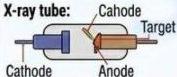
The diagram above is the schematic of an X-ray t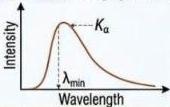
The graph above shows the intensity of X-rays vs
The figure shows the de Broglie standing-wave co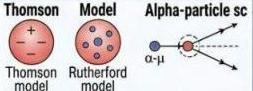
The icons above show Thomson's plum-pudding mode
The figure shows the K, L, and M electron shellsThe most striking result of Rutherford's gold-foil experiment that killed the Thomson model was:The energy of the $n = 3$ level of hydrogen is:In the Bohr model, the radius of the $n$th orbit of hydrogen scales as:The Balmer series of hydrogen corresponds to transitions:In the Geiger–Marsden α-scattering experiment, the observation that MOST α-particles passed nearly UNDEFLECTEDBohr's FIRST postulate of the hydrogen atom states thatIn the Bohr model of the hydrogen atom, the energy of an electron in the $n^\text{th}$ orbit is given by $E_n Bohr's quantisation condition for the angular momentum $L$ of an electron in the $n^\text{th}$ orbit isWhen the electron in a hydrogen atom makes a transition from $n = 2$ (first excited state) DIRECTLY back to $nIn the Bohr model, the radius of the $n^\text{th}$ orbit of a hydrogen-LIKE atom of atomic number $Z$ is $r_n An $\alpha$-particle of energy $7.7\,\text{MeV}$ is directed head-on at a stationary gold nucleus ($Z = 79$). The ratio of the first excitation energy of a hydrogen atom ($E_2 - E_1$) to its ionisation energy from the grIn the Bohr model, an electron transitions from $n = 3$ to $n = 2$ in a hydrogen atom (the H-α line of the BalIn the Bohr model, the velocity of an electron in the $n^\text{th}$ orbit of hydrogen is given by $v_n \proptoAccording to de Broglie's interpretation of Bohr's quantisation, the circumference of the $n^\text{th}$ stableA photon of wavelength $\lambda = 102.6\,\text{nm}$ is incident on a ground-state hydrogen atom. The atom can