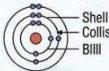
 The figure shows the K, L, and M electron shells of an atom. Which shell contains electrons with the *largest* binding energy?
AK-shell (innermost, $n = 1$)
BL-shell ($n = 2$)
CM-shell ($n = 3$)
DAll shells have equal binding energy
Answer & Solution
Correct answer: A. K-shell (innermost, $n = 1$)
Binding energy scales as $|E_n| \propto Z^2/n^2$. The K-shell ($n=1$) sits closest to the nucleus, feels the strongest Coulomb attraction, and has the largest $|E_n|$. This is why ejecting a K-shell electron requires far more energy than knocking out an L- or M-shell electron — and why $K_\alpha, K_\beta$ X-rays are much higher-frequency than visible/UV emissions.
Related questions
The ionisation energy of the hydrogen atom is about:The lowest energy state of an atom is called the:The energy of the emitted photon equals the difference between the:By Bohr's third postulate, a transition to lower energy emits a:Allowed angular momenta are integral multiples of h divided by:Bohr's second postulate quantises which quantity?Bohr called the stable non-radiating orbits the:By Bohr's first postulate, an electron in a stable orbit emits: