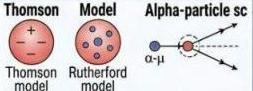
 The icons above show Thomson's plum-pudding model, Rutherford's nuclear model, and the $\alpha$-particle scattering experiment. Which model was proposed *to explain* the back-scattering observed in $\alpha$-particle scattering?
ASchrödinger's wave-mechanical model
BRutherford's nuclear model
CBohr's quantised-orbit model
DThomson's plum-pudding model
Answer & Solution
Correct answer: B. Rutherford's nuclear model
Rutherford proposed his nuclear model specifically to account for the small fraction of $\alpha$ particles that scattered through large angles in the gold-foil experiment. Thomson's plum-pudding model could not — it predicted only small deflections from a diffuse charge cloud. Bohr came later, building on Rutherford's nucleus by adding quantised orbits to explain spectral lines.
Related questions
The ionisation energy of the hydrogen atom is about:The lowest energy state of an atom is called the:The energy of the emitted photon equals the difference between the:By Bohr's third postulate, a transition to lower energy emits a:Allowed angular momenta are integral multiples of h divided by:Bohr's second postulate quantises which quantity?Bohr called the stable non-radiating orbits the:By Bohr's first postulate, an electron in a stable orbit emits: