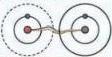
 The figure shows the de Broglie standing-wave condition for an electron in a stable Bohr orbit. The relation it expresses is
A$r = n\lambda$
B$\lambda = h\cdot 2\pi r$
C$2\pi r = n\lambda$
D$2\pi r = \left(n + \tfrac{1}{2}\right)\lambda$
Answer & Solution
Correct answer: C. $2\pi r = n\lambda$
A stable orbit requires the electron's de Broglie wave to interfere constructively with itself after one revolution — i.e. an integer number of wavelengths fit around the circumference: $2\pi r = n\lambda$. Substituting $\lambda = h/(mv)$ recovers Bohr's quantisation $mvr = \tfrac{nh}{2\pi} = n\hbar$. So Bohr's ad-hoc rule is exactly de Broglie's standing-wave condition.
Related questions
The ionisation energy of the hydrogen atom is about:The lowest energy state of an atom is called the:The energy of the emitted photon equals the difference between the:By Bohr's third postulate, a transition to lower energy emits a:Allowed angular momenta are integral multiples of h divided by:Bohr's second postulate quantises which quantity?Bohr called the stable non-radiating orbits the:By Bohr's first postulate, an electron in a stable orbit emits: