NEET UG Ray Optics — practice questions
64 free MCQs with worked solutions. Tap any question for the answer + explanation, or practice them all in the app.
Practice NEET UG Ray Optics in the app →The relation between focal length f and radius of curvature R for a spherical mirror is:In the Cartesian sign convention used in ray optics:The mirror equation (relating object distance u, image distance v, focal length f) is:The linear magnification produced by a spherical mirror is given by: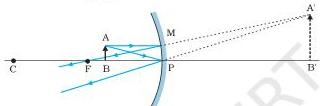
An An object placed at 5 cm in front of a concave mirror (R = 15 cm; f = −7.5 cm) forms an image that is:A real image formed by a mirror is one that:A convex (diverging) mirror always forms an image that is:If n₂₁ is the refractive index of medium 2 w.r.t. medium 1, then n₁₂ equals:When light passes through a rectangular glass slab, the emergent ray is:A coin lies at the bottom of a tank of water (refractive index n_w). To an observer looking from directly abovTotal internal reflection (TIR) occurs when:For light going from a medium of refractive index n to air, the critical angle i_c is given by:The critical angle for diamond (n ≈ 2.42) and water (n ≈ 1.33) is approximately:Optical fibres transmit signals using:For refraction at a single spherical surface from medium 1 (n₁) to medium 2 (n₂), the relation between object The lens-maker's formula for a thin lens (refractive index n) with radii of curvature R₁ and R₂ is:The magnification produced by a thin lens is:The power P of a lens with focal length f (in metres) is:A convex lens of focal length 20 cm forms a real, inverted image of an object placed at 30 cm in front of it. For a prism, the angle of deviation D is related to the angle of prism A and refractive index n by (at minimumDispersion of white light by a prism occurs because:Which colour of light deviates LEAST when white light passes through a glass prism?The speed of light in vacuum is approximately:'Optical density' of a medium is:For a concave lens (diverging lens), the image of a real object is always:A concave mirror of focal length $20$ cm forms a real image at $30$ cm from the pole. The object is at:Light enters a glass slab ($n = 1.5$) from air ($n = 1$) at angle of incidence $30^\circ$. The angle of refracA glass-to-air interface has refractive index ratio $n = 1.5$. The critical angle for total internal reflectioA convex lens has focal length $+10$ cm. A pencil placed $30$ cm from the lens forms an image at:Snell's law of refraction at the boundary between two media of refractive indices $n_1$ and $n_2$ statesThe CRITICAL ANGLE for total internal reflection at the boundary between a denser medium (refractive index $n$The relationship between the focal length $f$ and the radius of curvature $R$ for a SPHERICAL MIRROR isUsing the standard sign convention (light travels left to right, distances measured from pole, +ve to right), An object is placed at $30\,\text{cm}$ in front of a concave mirror of focal length $20\,\text{cm}$. The imageThe LENSMAKER'S formula for a thin lens of refractive index $n$ (in air) with radii of curvature $R_1$ and $R_The POWER of a lens (in diopters, D) is defined asTwo thin lenses of powers $+5\,\text{D}$ and $-3\,\text{D}$ are placed in CONTACT. The total power of the combOptical fibres use TOTAL INTERNAL REFLECTION to transmit light over long distances. The MAIN condition for theA converging lens of focal length $20\,\text{cm}$ produces a real image at $30\,\text{cm}$ from the lens. The Light passing through a PRISM is dispersed because different colours of light haveWhen light travels from one medium to another, which property of the wave REMAINS UNCHANGED?An object is placed at the FOCUS of a concave mirror ($u = f$, both negative). The image forms atThe phenomenon by which the apparent position of a star near the horizon appears slightly higher than its actuIn NCERT's sign convention for spherical mirrors, distances are measuredThe mirror equation relates u, v and f asTotal internal reflection requires light to travel fromFor a thin lens, the focal length is the distance from the optical centre toThe power P of a lens of focal length f (in metres) is given byAn object is placed 30 cm from a concave mirror of focal length 20 cm. The image distance isRefractive index of water with respect to air is 4/3. The critical angle for a water–air interface is approximA convex lens of focal length 20 cm is placed in contact with a concave lens of focal length 25 cm. The power Light passes from air (n=1) into glass (n=1.5) at an incidence angle of 60°. Using Snell's law, the angle of rFor a thin prism of small refracting angle A and refractive index n, the deviation δ is approximatelyAn astronomical telescope in normal adjustment has an objective of focal length 100 cm and an eyepiece of focaAn object is placed 15 cm from a convex lens of focal length 10 cm. The image isThe apparent depth of an object lying at the bottom of a pool of water (n = 4/3) is, in terms of its real deptGlass has refractive index 1.5 with respect to air. A light ray inside the glass strikes the glass–air boundarA compound microscope has an objective of focal length 1.0 cm and an eyepiece of focal length 5.0 cm. With theA converging lens of focal length f is split along its principal axis into two semicircular halves and the halRefraction at a single convex spherical surface: an object in air (n₁ = 1) at distance 20 cm from a glass (n₂ A thin prism of refracting angle 5° is made of glass with n = 1.5. The deviation δ of a light ray passing throA Galilean telescope (objective convex, eyepiece concave) has objective focal length 20 cm and eyepiece focal Two thin convex lenses, each of focal length 20 cm, are placed coaxially 10 cm apart in air. The equivalent fo