NEET UG Chemical Bonding and Molecular Structure — practice questions
120 free MCQs with worked solutions. Tap any question for the answer + explanation, or practice them all in the app.
Practice NEET UG Chemical Bonding and Molecular Structure in the app →According to the octet rule, atoms achieve stability by attaining an outer shell configuration of:The number of valence electrons in the Lewis dot symbol of nitrogen is:In the Lewis structure of CO₃²⁻, the total number of valence electrons to be accounted for is:For the NH₄⁺ ion, the total valence electrons available for writing the Lewis structure is:In a Lewis structure, the formal charge on an atom is calculated as: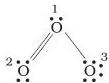
In this LewisWhich of the following compounds is an example of *incomplete* octet of the central atom?Expanded octets are possible from the third period onwards because:Which of the following statements about lattice enthalpy is correct?For the formation of NaCl(s) from Na(g) and Cl(g), the ionisation enthalpy of Na is +495.8, electron-gain enthWhich of the following is most likely to have the greatest covalent character (Fajans' rules)?Per Fajans' rules, which cation is the most polarising for cations of the same size and charge?Ionic bonds are formed most easily between elements with:Bond length is defined as the:Among H–H, F–F, Cl–Cl, Br–Br, I–I, the bond length is shortest for:With increase in bond order from single → double → triple, bond length and bond enthalpy respectively:The bond dissociation enthalpy of N₂ is approximately 946 kJ mol⁻¹ while that of O₂ is 498 kJ mol⁻¹. This is pThe average O–H bond enthalpy in water is calculated from the two stepwise dissociation values (502 and 427 kJExperimentally, both O–O bonds in ozone (O₃) are found to be of equal length (128 pm), intermediate between O–Which of the following statements about resonance is INCORRECT?The dipole moment of CO₂ is zero because:Despite F being more electronegative than H, μ(NH₃) > μ(NF₃) because:Among the following, which molecule has zero net dipole moment?One Debye unit (1 D) is equivalent to:According to VSEPR theory, the order of repulsion between electron pairs is:The shape of a molecule of type AB₄ (no lone pair on A), e.g., CH₄, is:The shape of SF₄ is:The shape of ClF₃ is:XeF₄ adopts which geometry?The HOH bond angle in water (≈ 104.5°) is *less* than the ideal tetrahedral angle of 109.5° because: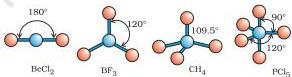
In the molecular The shape of NH₃ is trigonal pyramidal with a bond angle of about 107°, whereas BF₃ is trigonal planar with boWhich of the following overlaps is positive (gives bonding)?A sigma (σ) bond is formed by:A pi (π) bond is characterised by:In sp hybridisation, each hybrid orbital has the following s and p character:In BeCl₂ (gaseous), the central Be is sp-hybridised. The molecular geometry and Cl–Be–Cl bond angle are:The hybridisation of the central atom and shape of NH₃ are:Hybridisation of the central atom in PCl₅ is:In PCl₅, the axial P–Cl bonds are slightly *longer* than the equatorial ones because:The hybridisation of S in SF₆ is:The hybridisation of each carbon in ethyne (C₂H₂) is:According to MO theory, the bond order in a molecule is:Why does the He₂ molecule not exist according to MO theory?The paramagnetism of O₂ is explained by MO theory because the molecule has:For homonuclear diatomic molecules of B₂, C₂, N₂, the correct MO energy ordering is:The bond order in N₂, O₂ and O₂²⁻ (peroxide) are respectively:A hydrogen bond is formed when an H atom is covalently bonded to:Which of the following is an example of *intramolecular* hydrogen bonding?The magnitude of hydrogen bonding in a compound is:Isoelectronic species N₂, CO and NO⁺ all have a bond order of:The dipole moment of a molecule of the form AB_n depends on:The order of increasing polarity in HCl, $\mathrm{CO}_{2}$ , $\mathrm{H}_{2}\mathrm{O}$ and HF molecules isStability of the species $Li_2$, $Li_2^-$ and $Li_2^+$ increases in the order of:Which of the following statement regarding $NH_{3}$ and $NF_{3}$ is correct?The shape of $AsF_5$ according to VSEPR theory:
 isWhich molecule is non-polar despite having polar bonds?The bond order of the oxygen molecule O₂ (by molecular orbital theory) isA coordinate (dative) bond differs from a normal covalent bond in thatWhich species has sp hybridisation on the central atom?As bond order increases, bond lengthAn ionic bond forms byThe shape of NH₃ is pyramidal rather than planar becauseWhich has the highest dipole moment?Among the following, which is paramagnetic?Formal charge on an atom = Per NCERT §4.1, the KOSSEL-LEWIS approach (1916) explains chemical bonding in terms of which fundamental idea?Per NCERT §4.1.1, the OCTET RULE states which of the following?Per NCERT §4.1.5, which of the following is an example of an INCOMPLETE octet of the central atom?Per NCERT §4.1.5, which examples illustrate an EXPANDED octet (more than 8 e⁻ around central atom)?Per NCERT §4.1.5 (odd-electron molecules), which species violates the octet rule because of an ODD electron coPer NCERT §4.1.4, the FORMAL CHARGE on an atom in a Lewis structure is given by which formula?Per NCERT §4.1.4, formal charges on the central O atom + terminal O atoms in OZONE (O₃) Lewis structure are whPer NCERT §4.2, IONIC bonds form most readily between elements with which combination of properties?Per NCERT §4.2.1, the LATTICE ENTHALPY of an ionic solid is defined as which quantity?Per NCERT §4.2, for NaCl formation: IE(Na) = +496 kJ/mol, ΔₑgH(Cl) = −349 kJ/mol — these alone are positive (+Per NCERT §4.3.2, the H-O-H BOND ANGLE in water molecule is which value?Per NCERT §4.3.4 (bond order), which trio of N₂, CO, and NO⁺ have which property in common — and why?Per NCERT §4.4, the VSEPR theory (Sidgwick-Powell 1940; refined by Nyholm-Gillespie 1957) predicts molecular sPer NCERT §4.4, the order of repulsion between electron pairs in VSEPR is which?Per NCERT Table 4.6, what is the geometry of a molecule of type AB₅ with NO lone pairs on the central atom (e.Per NCERT Table 4.6, what is the geometry of a molecule of type AB₆ with NO lone pairs (e.g. SF₆)?Per NCERT Table 4.7, the shape of SF₄ (5 e⁻ pairs: 4 bp + 1 lp around S) is which?Per NCERT Table 4.7, the shape of XeF₄ (4 bp + 2 lp on Xe) is which?Per NCERT Table 4.8, the H-N-H bond angle in NH₃ is which value, and why is it less than the tetrahedral 109.5Per NCERT §4.3.6 (Debye conversion), 1 DEBYE equals how many C·m, and the unit honours which scientist?Per NCERT §4.3.6 + Table 4.5, why is the dipole moment of BF₃ ZERO although each B-F bond is polar?Per NCERT §4.3.6, why is dipole moment of NH₃ (1.47 D) MUCH GREATER than that of NF₃ (0.23 D) despite F being Per NCERT §4.3.5, the concept of RESONANCE is invoked when which condition holds?Per NCERT §4.3.5 (misconceptions), which statement about RESONANCE is INCORRECT?Per NCERT §4.5, Valence Bond (VB) theory was introduced by which scientists, in which year, and was later devePer NCERT §4.5.4, the SIGMA (σ) bond and PI (π) bond differ in which way?Per NCERT §4.5.5, which type of bond is generally STRONGER and why?Per NCERT §4.6.1, in sp HYBRIDISATION (e.g. BeCl₂ in excited state), each hybrid orbital has what s and p charPer NCERT §4.6.1, BCl₃ has its boron sp² hybridised. What is the molecular geometry + bond angle?Per NCERT §4.6.1, in sp³ hybridisation (e.g. CH₄), each hybrid has 25% s + 75% p character. What is the H-C-H Per NCERT §4.6.2 (ethyne C₂H₂), the C-C triple bond is composed of which bonds, and the carbon atoms are whichPer NCERT §4.6.2 (ethene C₂H₄), the C=C double bond consists of what, and each carbon's hybridisation is whichPer NCERT §4.6.3, PCl₅ uses what hybridisation, and gives what geometry?Per NCERT §4.6.3, SF₆ uses what hybridisation, and gives what geometry?Per NCERT §4.6.3, why are the AXIAL P-Cl bonds in PCl₅ slightly LONGER (and weaker) than the equatorial ones?Per NCERT §4.5.3 (orbital-overlap directional argument), why does simple overlap of unhybridised C atomic orbiPer NCERT §4.7, Molecular Orbital (MO) theory was proposed by which scientists, in which year?Per NCERT §4.7.1, when two atomic orbitals ψ_A and ψ_B combine by LCAO, what two molecular orbitals form, and Per NCERT §4.7.5, the BOND ORDER from MOT is defined as which expression?Per NCERT §4.7.4, the ORDER of MO energies that applies to O₂ and F₂ is which?Per NCERT §4.8 (He₂), why does He₂ molecule NOT exist as a stable species?Per NCERT §4.8 (O₂), the MOT prediction for OXYGEN MOLECULE explains which experimental observation that earliPer NCERT §4.8 (O₂), the MOT bond order of oxygen is computed as which?Per NCERT §4.8 (Li₂), the BOND ORDER and magnetic nature of Li₂ from MOT are which?Per NCERT §4.7.5 (general rule), how does BOND LENGTH relate to BOND ORDER in MOT?Per NCERT §4.9, a HYDROGEN BOND forms when a hydrogen atom is between which two atoms?Per NCERT §4.9.2, the two types of H-bonds are INTERMOLECULAR and INTRAMOLECULAR. Which example is INTRAMOLECUPer NCERT §4.9.1, the magnitude of hydrogen bonding depends on the physical state of the compound — and is MAXThe bonding in NaCl on the kitchen salt jar is best described as:The shape of the methane (CH$_4$) molecule is:The hybridisation of carbon in ethyne (HC$\equiv$CH) is:Water has a much higher boiling point than H$_2$S (similar molar mass) because: