NEET UG Biotechnology: Principles and Processes — practice questions
65 free MCQs with worked solutions. Tap any question for the answer + explanation, or practice them all in the app.
Practice NEET UG Biotechnology: Principles and Processes in the app →The three basic steps in genetically modifying an organism are:Restriction endonucleases are nucleases that:In the name 'EcoRI', the components stand for:Restriction enzymes cut DNA in such a way that they produce 'sticky ends'. This is useful because: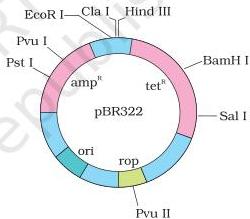
The cloning vector pBR3In biolistics (gene gun) used for plant transformation:To isolate DNA from bacterial cells, the cell wall is digested by:To remove contaminating RNA and protein during DNA isolation, the following enzymes are used respectively: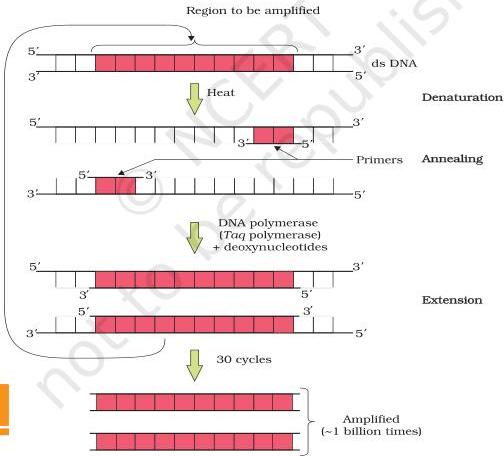
The three steps that makAfter repeated PCR cycles, the gene of interest can be amplified to approximately:Some uses of PCR amplification include:Downstream processing in industrial biotechnology refers to:Recombinant DNA can be inserted into a host cell where its protein product is produced. Such a protein expressIn a palindromic DNA sequence:Which of the following is the *correct* sequence of steps in basic recombinant DNA technology?Restriction enzymes are best described as:In recombinant DNA technology, plasmids are commonly used as:The three sequential steps of one PCR cycle are:Taq DNA polymerase used in PCR is obtained from:In gel electrophoresis, DNA fragments move toward the:The standard PLANT cell transformation method uses:The first MAJOR recombinant DNA pharmaceutical, released commercially in 1982, was:Bt cotton is resistant to BOLLWORM pests because it carries a gene from:In India, the regulatory body for releasing genetically modified organisms (GMOs) is:The two core techniques that enabled modern biotechnology as per NCERT Ch 9 areThe first construction of a recombinant DNA molecule (1972) was achieved byThe naming convention of the restriction enzyme EcoRI comes fromA recognition sequence acted on by a restriction endonuclease is characteristicallyThe "sticky ends" produced by a restriction endonuclease areThe role of DNA ligase in recombinant DNA technology is toA plasmid used as a vector in recombinant DNA work isThe presence of an "origin of replication" is important because itNucleases fall into two broad categories:A restriction enzyme cutting 5'-G|AATTC-3' leaves overhangs consisting ofWhich of the following is NOT a step in genetically modifying an organism as per NCERT?The first restriction endonuclease that recognised a specific 6-base sequence and cut DNA wasA "vector" in recombinant DNA technology serves toBiotechnology, per the European Federation of Biotechnology (EFB), is best defined asMaking multiple identical copies of a specific piece of DNA by linking it to an ori is termedWhich enzyme joins two cut DNA ends to make recombinant DNA?The first restriction endonuclease to be isolated was:Hind II cuts DNA on recognising a specific sequence of:Restriction enzymes are popularly called:Nucleases that remove nucleotides from DNA ends are:In gel electrophoresis DNA fragments move towards the:Which matrix is most commonly used to separate DNA fragments?In an agarose gel the fragment that travels farthest is the:Separated DNA bands become visible after staining with:Cutting a stained DNA band out of the gel and recovering it is:The vector sequence from which replication begins is the:An antibiotic resistance gene on a vector serves mainly as a:A foreign gene ligated at the BamH I site of pBR322 destroys:Colonies whose beta galactosidase gene carries an insert appear:Loss of gene function caused by a DNA insert inside it is:Which plasmid was reworked into a cloning vector for plants?Bacterial cells are made competent by treating them with a divalent:Recombinant DNA uptake is helped by a brief heat shock at:Bombarding plant cells with DNA coated gold particles is called:Micro-injection puts recombinant DNA directly into the:PCR amplifies a chosen segment using two sets of:The thermostable polymerase used in PCR is taken from:Repeated cycles of PCR can amplify a segment about:Which enzyme is used to open plant cells before DNA isolation?Purified DNA finally precipitates out on adding chilled:Separation and purification of the final product is called: