AP EAMCET Mechanical Properties of Solids — practice questions
57 free MCQs with worked solutions. Tap any question for the answer + explanation, or practice them all in the app.
Practice AP EAMCET Mechanical Properties of Solids in the app →A $5$ kg block rests on a frictionless horizontal surface. A constant horizontal force of $20$ N is applied toA person of mass $60$ kg stands on a weighing scale in a lift. The lift accelerates upward at $2$ m/s². What iA block of mass $10$ kg slides down an inclined plane that makes an angle of $37°$ with the horizontal. The coTwo blocks of masses $3$ kg and $5$ kg are connected by a light inextensible string passing over a smooth pullA $2$ kg block is pressed against a vertical wall by a horizontal force $F$. The coefficient of static frictioA monkey of mass $30$ kg climbs a vertical rope hanging from the ceiling with an upward acceleration of $2$ m/Newton's FIRST law is also called the law of:Newton's SECOND law states:The SI unit of force is the:Frictional force between surfaces ALWAYS acts:Static friction f_s satisfies:Kinetic friction f_k is given by:For a body on a horizontal surface, the NORMAL FORCE N equals:In circular motion at radius r and speed v, the centripetal acceleration is:The ANGLE OF REPOSE φ is related to coefficient of friction by:A 5 kg object experiences a net force of 20 N. Find its acceleration:A 10 kg block on rough horizontal surface with μ_s = 0.3 just starts moving. Force applied:A block of mass 2 kg on a smooth incline at 30°. Acceleration down the incline (g = 10):A 1500 kg car accelerates from 0 to 30 m/s in 10 s. Average force on car:In a tug-of-war, team A pulls with 200 N, team B pulls oppositely with 250 N. The rope (light) experiences netNewton's THIRD law pair: when you push a wall, the wall pushes you. These forces:A block of mass 5 kg on a rough incline at 37° with μ_k = 0.4. Acceleration down (g = 10, sin 37° = 0.6, cos 3For a body on a 60° incline with μ = 0.5, the body:Two blocks: 3 kg ON TOP of 5 kg, μ between them = 0.5. The 5 kg block on smooth floor. Horizontal force F = 20An object's WEIGHT on Earth (g = 10) is 50 N. Its MASS is:A 5 kg block is pushed with 30 N along a frictionless surface. Acceleration:A massless pulley system has two blocks: m₁ = 6 kg and m₂ = 4 kg hanging on either side. Find acceleration of The angle of repose between a block and an incline is 30°. The coefficient of static friction is:A 100 g object is moving in a vertical circle. At the TOP of the loop, for minimum speed (string just slack), Limiting (max static) friction is INDEPENDENT of:A 2 kg block on rough incline at 45° with μ = 0.3. Determine if it stays at rest (g = 10, sin 45° = cos 45° = A 4 kg mass hangs from a spring scale in an elevator. Spring reads 32 N. The elevator is:A 3 kg block is pulled with F = 20 N at 30° above horizontal on rough surface (μ_k = 0.4). Find acceleration (In a uniform circular motion, the SPEED is constant but velocity changes direction. The acceleration:A car turns a corner of radius 50 m at 20 m/s. Minimum coefficient of friction needed (g = 10):A 50 kg person stands on a scale in an elevator accelerating UP at 2 m/s². Scale reading:Two equal masses (3 kg each) connected by a light string over a frictionless pulley. One on smooth horizontal A pendulum of mass m swings to amplitude angle θ. At the lowest point of swing, the TENSION in the string equaA car of mass 1000 kg moving at 36 km/h is stopped by brakes in 5 seconds. Average force exerted by brakes:Which of the following is the correct definition of **stress** in a deformed body?A material that returns to its original shape once the deforming force is removed is said to beThe SI unit of Young's modulus isOn the stress-strain curve of a ductile material, the **proportional limit** is the point up to whichA steel wire of length $L$ and cross-section $A$ is stretched by a force $F$, producing extension $\Delta L$. Two wires A and B of the same material have lengths in the ratio $1 : 2$ and diameters in the ratio $2 : 1$. TA uniform pressure $P$ is applied isotropically to a solid sphere of bulk modulus $K$. The fractional change iThe Poisson's ratio of a material is defined asThe theoretical range of Poisson's ratio for an isotropic material isThe elastic potential energy stored per unit volume in a stretched wire (within the elastic limit) isA steel rod is clamped rigidly at both ends and then heated through a temperature rise $\Delta T$. If $\alpha$A wire of length $L$, area $A$ and Young's modulus $Y$ is stretched by hanging a mass $m$ from its free end. T\n\nIn the stress-strain curve of a ductile mater\n\nThe area under the stress-strain curve from O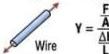\n\nThe diagram above shows a block under a tange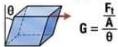\n\nFor the spherical body subjected to uniform e\n\nThe figure compares the stress-strain curves Two blocks of 2 kg and 3 kg connected by a string are pulled by 10 N on the 3 kg block (frictionless). The acc