
Start learning →

NEET UG Unit 4D: Organic Reaction Mechanisms & Techniques — practice questions

Explore 6 free Unit 4D: Organic Reaction Mechanisms & Techniques questions in NEET UG Chemistry. Open each question or exercise to read its content, reference answers and available explanation.

Practise Unit 4D: Organic Reaction Mechanisms & Techniques with Quill →

Unit 4D: Organic Reaction Mechanisms & Techniques questions and exercises with answers

Showing questions 1–6 of 6.

Worked practice questions

Choose the correct statement

  1. Saccharin is 650 times sweeter than sugar
  2. Alitame is 2000 times sweeter than sugar
  3. Sucralose is 160 times sweeter than sugar
  4. Aspartam is 550 times sweeter than sugar
Show answer and solution

Correct answer: B. Alitame is 2000 times sweeter than sugar

**Known relative sweetness values are:** saccharin about $550$ times, alitame about $2000$ times, sucralose about $600$ times, and aspartame about $200$ times sweeter than sucrose. Therefore only the statement about alitame matches correctly. After checking all four options, the correct choice is $\text{B}$.
Open this question →

Which of the following statements is not true?

  1. Pheromones are secreted outside the body by the insects
  2. Aspirin in analgesia and antipyretic
  3. Sucrose is a dipeptide commonly known as asparatame
  4. The DNA assists in the synthesis of RNA molecules
Show answer and solution

Correct answer: C. Sucrose is a dipeptide commonly known as asparatame

Check each statement. $A$ is true because pheromones are chemical signals released outside the body and used for communication in insects. $B$ is true because aspirin acts as an analgesic and antipyretic. $C$ is false because sucrose is a disaccharide, whereas aspartame is an artificial sweetener made from amino acid derivatives, not a dipeptide named sucrose. $D$ is true because DNA serves as the template for synthesis of RNA. **Therefore, the statement that is not true is $C$.**

Open this question →

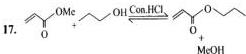
Above reaction is an example of ![](https://qallery.app/diagrams/v2_248e9aa17a93/img-038.jpeg)

Diagram for this question
  1. Esterification
  2. Saponification
  3. Hydrolysis
  4. Trans Esterification
Show answer and solution

Correct answer: D. Trans Esterification

The reaction shows an ester reacting with an alcohol in the presence of $\mathrm{HCl}$, and the alkoxy group of the ester changes from $\mathrm{OMe}$ to the propyl group while $\mathrm{MeOH}$ is formed as a by-product. This is exchange of the ester alkoxy group by another alcohol, which is called $\text{transesterification}$. **Therefore the correct option is $\mathrm{D}$.**

Open this question →

How to practise

  1. Choose a Unit 4D: Organic Reaction Mechanisms & Techniques question and try to work out your answer.
  2. Open the question to check the correct answer and read its worked solution.
  3. Continue in the app for bite-sized lessons, explanations and review with Quill. You can start without creating an account.

Put it into practice

Continue with Unit 4D: Organic Reaction Mechanisms & Techniques practice for NEET UG. Read explanations as you go. No signup form needed to start.

Practise Unit 4D: Organic Reaction Mechanisms & Techniques →

More Chemistry topics