JEE Main Ray and Wave Optics — practice questions
50 free MCQs with worked solutions. Tap any question for the answer + explanation, or practice them all in the app.
Practice JEE Main Ray and Wave Optics in the app →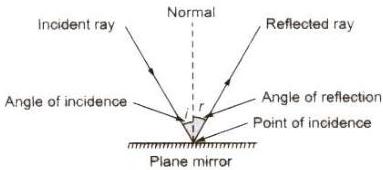
In the figure above, $AB$ is the incident ra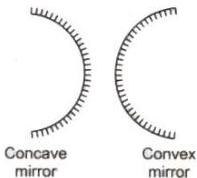
The figure shows two spherical mirrors. The 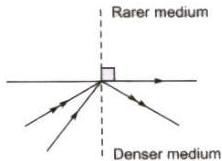
The phenomenon illustrated in the figure ocA concave mirror of focal length $20$ cm forms a real image of an object placed $30$ cm from the mirror. Find The speed of light in a transparent medium of refractive index $1.5$ is approximately: (speed of light in vacuSnell's law of refraction states:For a plane mirror, image is:Focal length of a concave mirror with radius of curvature R:For a thin lens, lens-maker's formula:Refraction by a prism: deviation δ depends on:For the prism shown, the deviation δ depends on the angle of incidence i, refractive index n, and prism angle For the lens setup shown, the lensmaker's formula relates 1/f to the radii R₁, R₂ and refractive index n. The For the single-slit diffraction pattern shown, the angular position of the FIRST minimum from central maximum Direct vision prism: two prisms combined so net dispersion is zero but net deviation is not. The condition forSnell's law states:Total internal reflection occurs when light travels from medium of refractive index n₁ to n₂ (n₁ > n₂) at anglApparent depth of object at real depth d in water (n = 4/3) seen from above is:Refractive index of medium where speed of light is v is:For a concave mirror, focal length f relates to radius of curvature R as:Object placed beyond center of curvature C of a concave mirror gives image that is:For a convex lens, object placed at 2f forms image at:Power of a lens of focal length 20 cm (in dioptres):Two thin lenses with powers +5 D and -3 D in contact. Equivalent power:For thin prism of refracting angle A (small), deviation δ is approximately:Critical angle for glass-air interface (n_glass = 1.5):In optical fibers, light travels by:In Young's double slit experiment, fringe width β with screen at distance D and slit separation d:For YDSE with λ = 500 nm, d = 0.2 mm, D = 1 m, fringe width is:Resolving power of telescope with aperture D and wavelength λ (Rayleigh criterion):Brewster's law: at angle of polarization i_B, the relation between i_B and refractive index n is:Resolving power of microscope is proportional to:Two coherent sources of intensities I₁ and I₂ interfere. Maximum intensity in pattern:For thin-film interference (oil on water), constructive interference for reflection condition:Refractive index of medium 1 with respect to medium 2 (denoted ₁n₂ or n₁/n₂). If ₁n₂ = 1.5 and ₂n₃ = 4/3, thenSpeed of light in glass (n = 1.5) is approximately:Diffraction effects are more noticeable when the obstacle/aperture size is:For thin lens, when image distance equals object distance (|v| = |u|), object position is:Light enters a glass slab ($n = 1.5$) from air ($n = 1$) at angle of incidence $30^\circ$. The angle of refracIn Young's double slit, $\lambda = 600$ nm, slit separation $d = 0.5$ mm, screen distance $D = 1$ m. Fringe wiIn single-slit diffraction with $\lambda = 500$ nm and slit width $a = 0.1$ mm, the angular position of the fiPolaroid sunglasses reduce glare from a wet road most effectively because:Light passes from air to glass ($n = 1.5$). Brewster's angle is:An object is placed 30 cm from a concave mirror of focal length 20 cm. The image distance isAn object is placed 15 cm from a convex lens of focal length 10 cm. The image isThe apparent depth of an object lying at the bottom of a pool of water (n = 4/3) is, in terms of its real deptGlass has refractive index 1.5 with respect to air. A light ray inside the glass strikes the glass–air boundarA compound microscope has an objective of focal length 1.0 cm and an eyepiece of focal length 5.0 cm. With theA converging lens of focal length f is split along its principal axis into two semicircular halves and the halRefraction at a single convex spherical surface: an object in air (n₁ = 1) at distance 20 cm from a glass (n₂ A thin prism of refracting angle 5° is made of glass with n = 1.5. The deviation δ of a light ray passing thro