Start learning →

JEE Advanced Chemical Reactions and Equations — practice questions

Explore 47 free Chemical Reactions and Equations questions in JEE Advanced Science. Open each question or exercise to read its content, reference answers and available explanation.

Practise Chemical Reactions and Equations with Quill →

Chemical Reactions and Equations questions and exercises with answers

Showing questions 1–30 of 47.

The notes calculate $\lambda_m^c$ using $\lambda_m^c = \dfrac{0.04 \times 1000}{0.1}$. What value is obtained?Read the answer and worked solution →What is the shape of a molecule whose central atom is $sp^3$ hybridised and has no lone pairs (e.g. $\mathrm{CH_4}$)?Read the answer and worked solution →![](https://qallery.app/diagrams/v2_bonding_seed_1/img-24.jpeg) What is the hybridisation of the central P atom in $\mathrm{PCl_5}$?Read the answer and worked solution →Arrange the bond angles of $\mathrm{H_2O}$, $\mathrm{NH_3}$ and $\mathrm{CH_4}$ in decreasing order.Read the answer and worked solution →Which of the following molecules has a **non-zero** dipole moment?Read the answer and worked solution →Using molecular orbital theory, the bond order of the $\mathrm{O_2}$ molecule is:Read the answer and worked solution →The modern periodic law states that the physical and chemical properties of elements are periodic functions of:Read the answer and worked solution →Elements of the modern periodic table are classified into how many blocks based on the differentiating electron?Read the answer and worked solution →Across a period from left to right, the atomic radius generally:Read the answer and worked solution →Which element has the highest first ionization energy in period 2?Read the answer and worked solution →An ELECTROVALENT (ionic) bond is formed when:Read the answer and worked solution →A COVALENT bond is formed by:Read the answer and worked solution →The octet rule states atoms tend to:Read the answer and worked solution →VSEPR stands for:Read the answer and worked solution →The shape of methane (CH₄) is:Read the answer and worked solution →Water (H₂O) molecular shape is:Read the answer and worked solution →Bond order in N₂ molecule is:Read the answer and worked solution →Dipole moment of CO₂ is:Read the answer and worked solution →In NH₃, hybridization of N is:Read the answer and worked solution →BF₃ has shape:Read the answer and worked solution →In SF₆, central S has hybridization:Read the answer and worked solution →The order of bond strength: single < double < triple. Bond LENGTHS go in:Read the answer and worked solution →Bond angle in NH₃ compared to H₂O:Read the answer and worked solution →Molecule with linear shape (besides CO₂):Read the answer and worked solution →Number of σ and π bonds in C₂H₄ (ethene):Read the answer and worked solution →Bond order from MOT (molecular orbital theory):Read the answer and worked solution →Among NaCl, HCl, H₂O — order of bond polarity:Read the answer and worked solution →Lattice energy of an ionic crystal depends on:Read the answer and worked solution →Hybridization in PCl₅ (gaseous phosphorus pentachloride):Read the answer and worked solution →XeF₄ has shape:Read the answer and worked solution →

Worked practice questions

The notes calculate $\lambda_m^c$ using $\lambda_m^c = \dfrac{0.04 \times 1000}{0.1}$. What value is obtained?

  1. 40
  2. 400
  3. 4000
  4. 4
Show answer and solution

Correct answer: B. 400

Compute $\lambda_m^c = \dfrac{0.04 \times 1000}{0.1} = \dfrac{40}{0.1} = 400$.

Open this question →

What is the shape of a molecule whose central atom is $sp^3$ hybridised and has no lone pairs (e.g. $\mathrm{CH_4}$)?

  1. Trigonal pyramidal
  2. Tetrahedral
  3. Bent / V-shaped
  4. Square planar
Show answer and solution

Correct answer: B. Tetrahedral

Four $sp^3$ hybrid orbitals point to the vertices of a regular tetrahedron, giving a bond angle of $109.5°$. With no lone pairs to compress these angles, the molecular geometry equals the electron-pair geometry. Methane ($\mathrm{CH_4}$) is the textbook example.

Open this question →

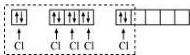
![](https://qallery.app/diagrams/v2_bonding_seed_1/img-24.jpeg) What is the hybridisation of the central P atom in $\mathrm{PCl_5}$?

  1. $sp^2$
  2. $sp^3d^2$
  3. $sp$
  4. $sp^3d$
Show answer and solution

Correct answer: D. $sp^3d$

P in $\mathrm{PCl_5}$ has five bonded chlorines and no lone pair. That gives five electron domains. The hybridisation needed is $sp^3d$ (one $s$ + three $p$ + one $d$ orbital = five hybrid orbitals). The molecular geometry is trigonal bipyramidal. $sp^3d^2$ would give six domains and an octahedral geometry, which is what you see in $\mathrm{SF_6}$, not $\mathrm{PCl_5}$.

Open this question →

How to practise

  1. Choose a Chemical Reactions and Equations question and try to work out your answer.
  2. Open the question to check the correct answer and read its worked solution.
  3. Continue in the app for bite-sized lessons, explanations and review with Quill. You can start without creating an account.

Put it into practice

Continue with Chemical Reactions and Equations practice for JEE Advanced. Read explanations as you go. No signup form needed to start.

Practise Chemical Reactions and Equations →

More Science topics