Direct vision prism: two prisms combined so net dispersion is zero but net deviation is not. The condition for zero dispersion is: 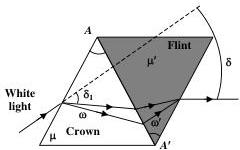
An₁ = n₂
BA₁ = A₂
CNo such combination possible
D(n_v - n_r)₁ A₁ = (n_v - n_r)₂ A₂
Answer & Solution
Correct answer: D. (n_v - n_r)₁ A₁ = (n_v - n_r)₂ A₂
For two prisms (angles A₁, A₂; refractive indices n₁, n₂): net dispersion (n_v - n_r)₁ A₁ - (n_v - n_r)₂ A₂ = 0 → (n_v - n_r)₁ A₁ = (n_v - n_r)₂ A₂ (using opposite orientations). Used in optical spectroscopes. Net deviation: (n_y - 1)₁ A₁ - (n_y - 1)₂ A₂ ≠ 0.
Related questions
A thin prism of refracting angle 5° is made of glass with n = 1.5. The deviation δ of a liRefraction at a single convex spherical surface: an object in air (n₁ = 1) at distance 20 A converging lens of focal length f is split along its principal axis into two semicirculaA compound microscope has an objective of focal length 1.0 cm and an eyepiece of focal lenGlass has refractive index 1.5 with respect to air. A light ray inside the glass strikes tThe apparent depth of an object lying at the bottom of a pool of water (n = 4/3) is, in teAn object is placed 15 cm from a convex lens of focal length 10 cm. The image isAn object is placed 30 cm from a concave mirror of focal length 20 cm. The image distance