The equipotential surfaces shown are around an isolated point charge. The shape and behaviour of these surfaces are best described by: 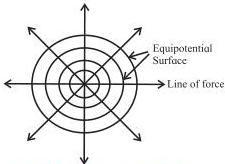
ARandom surfaces; equipotentials can have any shape near a point charge.
BConcentric spheres centred on the charge; $\vec E$ is radial and perpendicular to each surface.
CParallel planes; the field is uniform.
DCoaxial cylinders; $\vec E$ is along the axis.
Answer & Solution
Correct answer: B. Concentric spheres centred on the charge; $\vec E$ is radial and perpendicular to each surface.
For a point charge $V = kq/r$, so $V$ is constant for all points at the same $r$ — i.e. a sphere. $\vec E$ is radial, and (as Eq. 8.13 implies) always perpendicular to these spherical equipotentials. Concentric cylindrical surfaces would describe a line charge, not a point charge.
Related questions
Certain galvanometers use eddy currents to provide electromagnetic:The SI unit of inductance is the:Eddy current flow patterns are said to resemble swirling eddies in:Foucault lived from 1819 until:Who discovered eddy currents?Swirling induced currents in a metal plate are called:What in Faraday's equation represents Lenz's law?Lenz's law says the induced current opposes the change in: