Using Gauss's law for an infinitely long straight wire with linear charge density $\lambda$, the electric field intensity at perpendicular distance $r$ from the wire is: 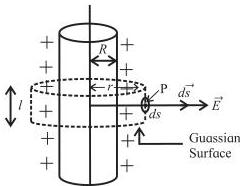
A$\dfrac{\lambda}{4\pi\varepsilon_0 r}$
B$\dfrac{\lambda}{2\pi\varepsilon_0 r^2}$
C$\dfrac{\lambda r}{2\pi\varepsilon_0}$
D$\dfrac{\lambda}{2\pi\varepsilon_0 r}$
Answer & Solution
Correct answer: D. $\dfrac{\lambda}{2\pi\varepsilon_0 r}$
Take a coaxial cylindrical Gaussian surface of length $l$, radius $r$. Charge enclosed $= \lambda l$. Flux through curved surface = $E \cdot 2\pi r l$ (caps contribute zero). Equating: $E \cdot 2\pi r l = \lambda l / \varepsilon_0$ ⇒ $E = \lambda/(2\pi\varepsilon_0 r)$.
Related questions
Certain galvanometers use eddy currents to provide electromagnetic:The SI unit of inductance is the:Eddy current flow patterns are said to resemble swirling eddies in:Foucault lived from 1819 until:Who discovered eddy currents?Swirling induced currents in a metal plate are called:What in Faraday's equation represents Lenz's law?Lenz's law says the induced current opposes the change in: