In the current-junction figure, suppose $I_1$, $I_2$, and $I_3$ are entering the node while $I_4$, $I_5$, and $I_6$ are leaving. If $I_4$ increases while all other currents remain unchanged, what must happen for KCL to remain satisfied? 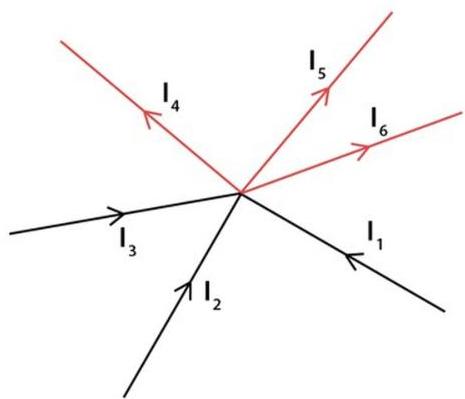
AOne of the entering currents must increase or one of the other leaving currents must decrease
BAll branch currents must become zero
CThe source voltage in some other loop must become zero
DThe node must acquire infinite charge
Answer & Solution
Correct answer: A. One of the entering currents must increase or one of the other leaving currents must decrease
KCL requires entering current to equal leaving current. If one leaving current increases and all others are unchanged, the equality is disturbed. To restore balance, either the total entering current must increase or another leaving current must decrease. Options B, C, and D do not follow from KCL.

Related questions
The reactance of a capacitor $C$ at frequency $f$ in an a.c. circuit is:A bird perched on a single high voltage wire is unharmed because:The two conservation laws embodied in Kirchhoff's rules are conservation of:The resistance offered by the cell itself is called:Which device detects the current in a Wheatstone bridge?In a Wheatstone bridge, the source is connected across the:The Wheatstone bridge is made up of how many resistors?At a junction, the current entering equals the current: