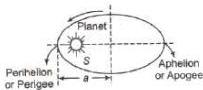
 Kepler's first law (law of orbits) states that each planet revolves around the Sun:
AIn a perfect circle with the Sun at its centre
BIn an elliptical orbit with the Sun at one focus
CIn a parabolic orbit
DIn a hyperbolic orbit
Answer & Solution
Correct answer: B. In an elliptical orbit with the Sun at one focus
Kepler's three laws of planetary motion:
1. **Law of orbits (first law)**: each planet moves in an *elliptical* orbit with the Sun at one focus (the other focus is empty space).
2. **Law of areas (second law)**: the line joining a planet to the Sun sweeps equal areas in equal times.
3. **Law of periods (third law)**: $T^2 \propto a^3$, where $a$ is the semi-major axis.
A circle is the special case of an ellipse where both foci coincide at the centre. Most planetary orbits are nearly circular but not exactly so. Mercury and Pluto's orbits have noticeable eccentricity. Parabolic (option C) and hyperbolic orbits are unbound trajectories.
Related questions
Tycho Brahe recorded his observations using:Kepler's three laws describe the motion of:The low escape speed of the moon explains why it has no:The moon's escape speed compared with the earth's is smaller by about:The escape speed for the moon works out to about:The law of periods uses which measurement of the ellipse?By the law of periods, the square of the period is proportional to:The law of areas explains why a planet moves slower when it is: