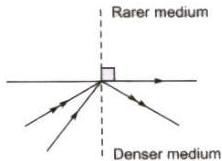
 The phenomenon illustrated in the figure occurs when a light ray:
Atravels from a rarer medium to a denser medium at any angle
Btravels from a denser medium to a rarer medium at any angle
Ctravels from a denser medium to a rarer medium at an angle greater than the critical angle
Dtravels from a rarer medium to a denser medium at an angle greater than the critical angle
Answer & Solution
Correct answer: C. travels from a denser medium to a rarer medium at an angle greater than the critical angle
**Total Internal Reflection (TIR)** requires two conditions to fire simultaneously:
1. Light is going from the **denser to rarer** medium (e.g. water → air).
2. The angle of incidence **exceeds the critical angle** $C$, where $\sin C = 1/\mu$.
If either condition fails the ray refracts (option B), or refraction never even arose (options A and D — going *into* a denser medium can never give TIR, the ray always refracts inward).
Related questions
Two thin convex lenses, each of focal length 20 cm, are placed coaxially 10 cm apart in aiA Galilean telescope (objective convex, eyepiece concave) has objective focal length 20 cmA thin prism of refracting angle 5° is made of glass with n = 1.5. The deviation δ of a liRefraction at a single convex spherical surface: an object in air (n₁ = 1) at distance 20 A converging lens of focal length f is split along its principal axis into two semicirculaA compound microscope has an objective of focal length 1.0 cm and an eyepiece of focal lenGlass has refractive index 1.5 with respect to air. A light ray inside the glass strikes tThe apparent depth of an object lying at the bottom of a pool of water (n = 4/3) is, in te