Reduction of glucose with sodium amalgam (Na-Hg) and water gives: 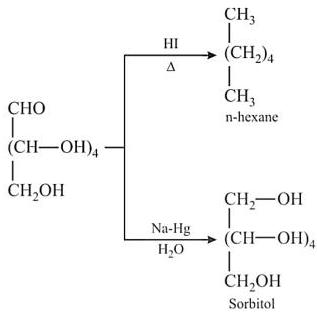
An-Hexane
BSaccharic acid
CSorbitol (a hexahydric alcohol)
DGluconic acid
Answer & Solution
Correct answer: C. Sorbitol (a hexahydric alcohol)
Mild reduction of -CHO in glucose to -CH₂OH gives sorbitol (D-glucitol). Strong HI reduction at high T removes all OH → n-hexane (proving 6-C straight chain). Bromine water (mild oxidation) → gluconic acid; HNO₃ → saccharic acid.
Related questions
In the DNA double helix adenine pairs with:Nucleotides in a chain are joined by which linkage?A base attached to a sugar without phosphate is called a:Which base occurs in RNA but not in DNA?The sugar found in a DNA molecule is:Water soluble vitamins must be eaten regularly because they are:Which set of vitamins is fat soluble?Enzymes speed a reaction by lowering its: