If two adjacent angles form a linear pair, which statement is always true? 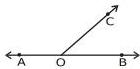
AThey are equal
BThey are complementary
CThey are supplementary
DThey are vertical angles
Answer & Solution
Correct answer: C. They are supplementary
A linear pair consists of two adjacent angles whose non-common arms are opposite rays. Therefore their sum is $180^{\circ}$, so they are supplementary. They need not be equal, complementary, or vertical.
Related questions
The study of inequalities is described as useful in solving problems in science and:A firm needing at least 6 units and at most 10 would write that as a:Which sign makes a statement an inequality rather than an equation?Unless stated otherwise, inequalities in that chapter are solved over the set of:The set of all values of the variable that make an inequality true is called its:Solving 4x plus 3 less than 6x plus 7 gives:When x is a real number in that inequality, the solution set is written as:When x is an integer in that inequality, the largest solution is: