A piece of land is an isosceles right triangle whose longest side is $98.2\,\mathrm{m}$. What is its perimeter, correct to two decimal places? 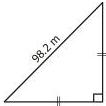
A$196.40\,\mathrm{m}$
B$208.88\,\mathrm{m}$
C$237.08\,\mathrm{m}$
D$294.60\,\mathrm{m}$
Answer & Solution
Correct answer: C. $237.08\,\mathrm{m}$
In an isosceles right triangle, if each equal side is $x$, then $x^2+x^2=(98.2)^2$. So $2x^2=9643.24$, hence $x^2=4821.62$ and $x\approx69.44$. Therefore perimeter $=69.44+69.44+98.2=237.08\,\mathrm{m}$.
Related questions
The study of inequalities is described as useful in solving problems in science and:A firm needing at least 6 units and at most 10 would write that as a:Which sign makes a statement an inequality rather than an equation?Unless stated otherwise, inequalities in that chapter are solved over the set of:The set of all values of the variable that make an inequality true is called its:Solving 4x plus 3 less than 6x plus 7 gives:When x is a real number in that inequality, the solution set is written as:When x is an integer in that inequality, the largest solution is: