Home › CBSE Class 8 › Physics › Force and Pressure › In a famous 17th-century demonstration, two meta…
In a famous 17th-century demonstration, two metallic hemispheres of 51 cm diameter were joined together and the air between them was pumped out. Eight horses on each side could not pull them apart. 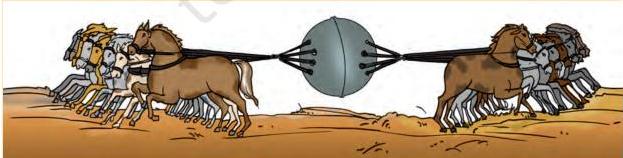 What is the BEST explanation for why the hemispheres could not be separated?
AOnce the air was removed, the atmospheric pressure outside pushed the hemispheres together with a force much larger than the horses could overcome.
BMagnetic attraction between the two metal pieces held them together.
CThe hemispheres were welded together by the pump.
DThe hemispheres were too heavy for the horses to lift.
Answer & Solution
Correct answer: A. Once the air was removed, the atmospheric pressure outside pushed the hemispheres together with a force much larger than the horses could overcome.
Removing the air inside left the inner pressure near zero. The atmospheric pressure outside, acting over the large surface area of the hemispheres, produced an inward force of several thousand newtons — far greater than what even sixteen horses could pull apart. The experiment was a dramatic illustration of how strong atmospheric pressure really is. Welding is fictitious (the pump only removed air, it did not join metal). Magnetism is not involved — the demonstration works with any metal. Weight is irrelevant: horses pull horizontally, not lift.
Related questions
The instrument used to measure atmospheric pressure is the:Atmospheric pressure on the human body is roughly 100,000 Pa. Why don't we feel crushed?Friction acts:Action and reaction forces:Why are dams built thicker at the bottom than at the top?A camel can walk easily on desert sand because:Pressure at the bottom of a tall water column compared with a short column:Why is it easier to break a watermelon by pressing a needle than by pressing the palm?