According to the notes and the graph, how does stopping potential change when the intensity of incident light is increased while keeping frequency fixed above threshold? 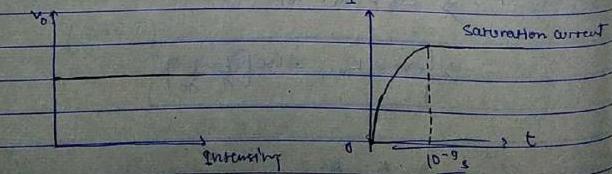
AIt increases linearly
BIt decreases linearly
CIt remains unchanged
DIt first increases and then decreases
Answer & Solution
Correct answer: C. It remains unchanged
Stopping potential depends on the maximum kinetic energy of emitted electrons, and that depends on frequency, not intensity. Increasing intensity increases the number of emitted electrons, but not their maximum kinetic energy. Hence the stopping potential remains unchanged.

Related questions
In gamma decay, what is emitted?A positron has the same mass as an electron but a charge that is:In beta decay, which particles may be emitted?In alpha decay, which nucleus is emitted?How many types of radioactive decay occur in nature?Radioactivity is a decay undergone by a nucleus that is:Becquerel's emission penetrated black paper and:Becquerel made his discovery while studying: