The stopping potential is defined as the minimum negative potential between the plates at which 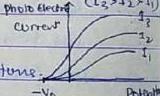
Athe saturation current becomes maximum
Bthe photoelectric current becomes zero
Cthe threshold frequency becomes zero
Dthe emitter plate starts glowing
Answer & Solution
Correct answer: B. the photoelectric current becomes zero
Stopping potential is the minimum reverse potential that prevents even the fastest photoelectrons from reaching the collector. At this potential, the photoelectric current becomes zero.

Related questions
In gamma decay, what is emitted?A positron has the same mass as an electron but a charge that is:In beta decay, which particles may be emitted?In alpha decay, which nucleus is emitted?How many types of radioactive decay occur in nature?Radioactivity is a decay undergone by a nucleus that is:Becquerel's emission penetrated black paper and:Becquerel made his discovery while studying: