Refer to the figure of the zinc rod in solution. The label near the rod indicates it acts as the anode because 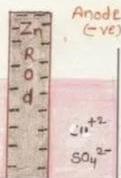
Asulfate ions are reduced on the rod surface
Bzinc ions from solution gain electrons and plate out
Czinc atoms leave the rod as $Zn^{2+}$, leaving electrons behind on the rod
Dcopper ions are oxidized near the rod
Answer & Solution
Correct answer: C. zinc atoms leave the rod as $Zn^{2+}$, leaving electrons behind on the rod
The figure shows a zinc rod labeled as the anode, and the notes explain why: zinc atoms go into solution as $Zn^{2+}$ while electrons remain on the rod, making it the oxidation electrode. That is the defining behavior of the anode in this cell.
Related questions
Reduction, in the classical sense, is the reverse of:Oxidation number and oxidation state are terms that are:The classical definition of oxidation looked at oxygen and:Which is a redox reaction according to the electron transfer view?Magnesium and sulphur burning in oxygen illustrate oxidation by the definition that is:Redox reactions are involved in phenomena that are physical and also:In disproportionation, the element in the reacting substance is in a state that is:A substance undergoing disproportionation must contain an element with at least how many o