Home › GUJCET › Chemistry › Ideal and Non-Ideal Solutions › The pV-curve shown represents a solution exhibit…
The pV-curve shown represents a solution exhibiting **negative** deviation from Raoult's law. Which mixture is an example of this behaviour? 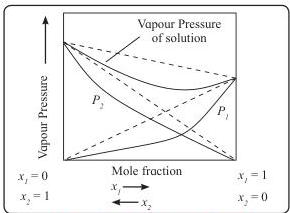
AAir (oxygen + nitrogen)
BEthanol + acetone
CCarbon disulphide + acetone
DChloroform + acetone
Answer & Solution
Correct answer: D. Chloroform + acetone
Negative deviation: solute–solvent interactions are **stronger** than like-like. Chloroform + acetone form a hydrogen bond between the C–H of CHCl₃ and the carbonyl O of acetone, holding molecules tighter and lowering escape rate — vapour pressure dips below Raoult. Phenol + aniline is the other classic example. Ethanol + acetone shows positive deviation.
Related questions
The nitric acid and water azeotrope holds nitric acid at about:Distilling an ethanol and water mixture stops at about:A large negative deviation produces an azeotrope that is:A large positive deviation produces an azeotrope that is:The components of an azeotrope cannot be separated by:Binary mixtures boiling at a constant temperature are called:Chloroform and acetone form a hydrogen bond, so the vapour pressure:A mixture of phenol and aniline shows: