An infinitely long conductor $PQR$ is bent to form a right angle as shown. A current $I$ flows through $PQR$. The magnetic field due to this current at the point $M$ is $H_{1}$. Now another infinitely long straight conductor $QS$ is connected at $Q$ so that the current is $I/2$ in $QR$ as well as in $QS$. The current in $PQ$ remaining unchanged. The magnetic field at $M$ is now $H_{2}$. The ratio $H_{1}/H_{2}$ is given by 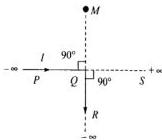
A$\frac{1}{2}$
B1
C$\frac{2}{3}$
D2
Answer & Solution
Correct answer: D. 2
At $M$, the horizontal part $PQ$ gives no field because for every current element on $PQ$, the position vector toward $M$ is along the same line, so $d\vec{l} \times \vec{r} = 0$.
So initially only the vertical semi-infinite part $QR$ contributes.
For a semi-infinite straight wire at perpendicular distance $a$,
$$H = \frac{I}{4\pi a}$$
Hence,
$$H_1 = \frac{I}{4\pi a}$$
After connecting $QS$, the current in $QR$ becomes $\frac{I}{2}$ and the current in $QS$ is also $\frac{I}{2}$.
At $M$, the branch $QS$ also gives no field, since $M$ lies on the same straight line produced through $QS$, so again $d\vec{l} \times \vec{r} = 0$ for that branch.
Thus only $QR$ contributes in the new case:
$$H_2 = \frac{I/2}{4\pi a} = \frac{I}{8\pi a}$$
Therefore,
$$\frac{H_1}{H_2} = \frac{I/(4\pi a)}{I/(8\pi a)} = 2$$
This matches option $D$.
Related questions
A storage battery of emf 8.0 V and internal resistance 0.5 $\Omega$ is charged by a 120 V The number density of free electrons in a copper wire is $8.5 \times 10^{28}\ \text{m}^{-3A heating element has resistance 100 $\Omega$ at 27.0 °C. Its temperature coefficient of rA wire of length 15 m and uniform cross-section $6.0 \times 10^{-7}\ \text{m}^2$ has a meaThe statement "$V = IR$ is itself the statement of Ohm's law" is, according to the text, iCurrent through an area of cross-section is treated as a scalar quantity in this chapter eA Wheatstone bridge has arms AB = 100 $\Omega$, BC = 10 $\Omega$, CD = 5 $\Omega$, DA = 60In a Wheatstone bridge the unknown resistance is placed in the fourth arm. Known resistanc