For a positively charged particle moving in a $x - y$ plane initially along the $x$-axis, there is a sudden change in its path due to the presence of electric and/or magnetic fields beyond $P$. The curved path is shown in the $x - y$ plane and is found to be non-circular. Which one of the following combinations is possible 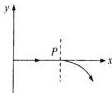
A$\vec{E} = 0; \vec{B} = b\hat{i} + c\hat{k}$
B$\vec{E} = a\hat{i}; \vec{B} = c\hat{k} + a\hat{i}$
C$\vec{E} = 0; \vec{B} = c\hat{j} + b\hat{k}$
D$\vec{E} = a\hat{i}; \vec{B} = c\hat{k} + b\hat{j}$
Answer & Solution
Correct answer: B. $\vec{E} = a\hat{i}; \vec{B} = c\hat{k} + a\hat{i}$
Initially the particle moves along $+x$, so $\vec{v}=v\hat{i}$.
For the motion to remain in the $x-y$ plane, the net force should have no $\hat{k}$ component.
Check each option using
$$\vec{F}=q(\vec{E}+\vec{v}\times\vec{B}).$$
For option $A$,
$$\vec{B}=b\hat{i}+c\hat{k}.$$
Then
$$\vec{v}\times\vec{B}=v\hat{i}\times(b\hat{i}+c\hat{k})=-vc\hat{j}.$$
So the force is only along $-y$. With only magnetic force, speed stays constant and the path is circular, not non-circular. So $A$ is not possible.
For option $B$,
$$\vec{E}=a\hat{i},\quad \vec{B}=c\hat{k}+a\hat{i}.$$
Then
$$\vec{v}\times\vec{B}=v\hat{i}\times(c\hat{k}+a\hat{i})=-vc\hat{j}.$$
Hence there is an electric force along $+x$ and a magnetic force along $-y$. The $x$-component changes the speed, while the $y$-component bends the path. Therefore the trajectory in the $x-y$ plane can be non-circular. So this is possible.
For option $C$,
$$\vec{B}=c\hat{j}+b\hat{k}.$$
Then
$$\vec{v}\times\vec{B}=v\hat{i}\times(c\hat{j}+b\hat{k})=vc\hat{k}-vb\hat{j}.$$
There is a $\hat{k}$ component, so motion will leave the $x-y$ plane. Not possible.
For option $D$,
$$\vec{E}=a\hat{i},\quad \vec{B}=c\hat{k}+b\hat{j}.$$
Then
$$\vec{v}\times\vec{B}=v\hat{i}\times(c\hat{k}+b\hat{j})=-vc\hat{j}+vb\hat{k}.$$
Again there is a $\hat{k}$ component, so motion will not stay in the $x-y$ plane. Not possible.
After comparing all options, only $B$ gives motion confined to the $x-y$ plane and non-circular trajectory.
Related questions
A storage battery of emf 8.0 V and internal resistance 0.5 $\Omega$ is charged by a 120 V The number density of free electrons in a copper wire is $8.5 \times 10^{28}\ \text{m}^{-3A heating element has resistance 100 $\Omega$ at 27.0 °C. Its temperature coefficient of rA wire of length 15 m and uniform cross-section $6.0 \times 10^{-7}\ \text{m}^2$ has a meaThe statement "$V = IR$ is itself the statement of Ohm's law" is, according to the text, iCurrent through an area of cross-section is treated as a scalar quantity in this chapter eA Wheatstone bridge has arms AB = 100 $\Omega$, BC = 10 $\Omega$, CD = 5 $\Omega$, DA = 60In a Wheatstone bridge the unknown resistance is placed in the fourth arm. Known resistanc