A uniform but time-varying magnetic field $B(t)$ exists in a circular region of radius $a$ and is directed into the plane of the paper, as shown. The magnitude of the induced electric field at point $P$ at a distance $r$ from the centre of the circular region 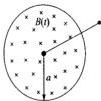
Ais zero
Bdecreases as $\frac{1}{r}$
Cincreases as $r$
Ddecreases as $\frac{1}{r^2}$
Answer & Solution
Correct answer: B. decreases as $\frac{1}{r}$
Using Faraday's law for a circular path of radius $r$ centered on the field region, $$\oint \vec{E}\cdot d\vec{l}=-\frac{d\Phi_B}{dt}.$$ From the figure, point $P$ is outside the magnetic region, so $r>a$. The magnetic flux linked by this path comes only from the field-filled circle of radius $a$, hence $$\Phi_B=B(t)\pi a^2.$$ Therefore, $$E(2\pi r)=\pi a^2\left|\frac{dB}{dt}\right|.$$ So the magnitude of the induced electric field is $$E=\frac{a^2}{2r}\left|\frac{dB}{dt}\right|.$$ Thus it varies inversely with $r$, so after checking the options, the correct choice is $\text{B}$.
Related questions
A storage battery of emf 8.0 V and internal resistance 0.5 $\Omega$ is charged by a 120 V The number density of free electrons in a copper wire is $8.5 \times 10^{28}\ \text{m}^{-3A heating element has resistance 100 $\Omega$ at 27.0 °C. Its temperature coefficient of rA wire of length 15 m and uniform cross-section $6.0 \times 10^{-7}\ \text{m}^2$ has a meaThe statement "$V = IR$ is itself the statement of Ohm's law" is, according to the text, iCurrent through an area of cross-section is treated as a scalar quantity in this chapter eA Wheatstone bridge has arms AB = 100 $\Omega$, BC = 10 $\Omega$, CD = 5 $\Omega$, DA = 60In a Wheatstone bridge the unknown resistance is placed in the fourth arm. Known resistanc