For refraction at an interface between two media, Snell's law is correctly written as 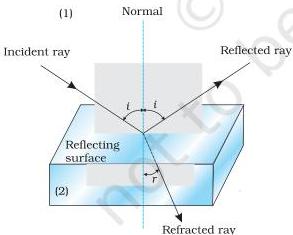
A$\dfrac{\sin r}{\sin i}=n_{21}$
B$\dfrac{\sin i}{\sin r}=n_{21}$
C$\dfrac{\tan i}{\tan r}=n_{21}$
D$\sin i+\sin r=n_{21}$
Answer & Solution
Correct answer: B. $\dfrac{\sin i}{\sin r}=n_{21}$
Snell's law states that for a given pair of media, $\dfrac{\sin i}{\sin r}=n_{21}$, where $n_{21}$ is the refractive index of medium 2 with respect to medium 1. The ratio is independent of the angle of incidence for the given wavelength.
Related questions
Which colour travels fastest in a glass prism?Dispersion happens because the refractive index differs with:Violet light has a wavelength of about:In the visible spectrum, red light lies at the:A lens of power minus 4.0 D is a concave lens of focal length:A prescribed lens of power plus 2.5 D is a convex lens of focal length:The power of a converging lens is:A lens of focal length one metre has a power of: