Which set of conditions is necessary for total internal reflection to occur at an interface? 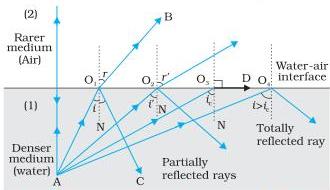
ALight must travel from a rarer medium to a denser medium, and the angle of incidence must be less than the critical angle.
BLight must travel from a denser medium to a rarer medium, and the angle of incidence must exceed the critical angle.
CLight must travel from air to glass, and the angle of refraction must be $90^\circ$.
DLight must strike the interface normally from any medium.
Answer & Solution
Correct answer: B. Light must travel from a denser medium to a rarer medium, and the angle of incidence must exceed the critical angle.
Total internal reflection occurs only when light goes from an optically denser medium to a rarer medium. As the angle of incidence increases, the refracted angle increases until it reaches $90^\circ$ at the critical angle; beyond this, refraction is impossible and the ray is totally reflected.
Related questions
Which colour travels fastest in a glass prism?Dispersion happens because the refractive index differs with:Violet light has a wavelength of about:In the visible spectrum, red light lies at the:A lens of power minus 4.0 D is a concave lens of focal length:A prescribed lens of power plus 2.5 D is a convex lens of focal length:The power of a converging lens is:A lens of focal length one metre has a power of: