A lens has power $-4.0\,\mathrm{D}$. Which interpretation is correct? 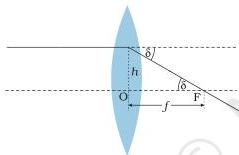
AIt is a convex lens of focal length $+25\,\mathrm{cm}$
BIt is a concave lens of focal length $-25\,\mathrm{cm}$
CIt is a convex lens of focal length $-40\,\mathrm{cm}$
DIt is a concave lens of focal length $+40\,\mathrm{cm}$
Answer & Solution
Correct answer: B. It is a concave lens of focal length $-25\,\mathrm{cm}$
Power and focal length are related by $P=1/f$ when $f$ is in metres. For $P=-4.0\,\mathrm{D}$, $$f=\frac{1}{-4.0}=-0.25\,\mathrm{m}=-25\,\mathrm{cm}.$$ Negative power means a diverging lens, i.e. a concave lens.
Related questions
Which colour travels fastest in a glass prism?Dispersion happens because the refractive index differs with:Violet light has a wavelength of about:In the visible spectrum, red light lies at the:A lens of power minus 4.0 D is a concave lens of focal length:A prescribed lens of power plus 2.5 D is a convex lens of focal length:The power of a converging lens is:A lens of focal length one metre has a power of: