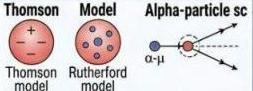
 The figure depicts an early atomic model. In this model:
APositive charge is uniformly distributed throughout the atom and electrons are embedded randomly inside it
BElectrons exist only at quantized energy levels in stationary orbits
CThe atom is mostly empty space with a dense, positively charged nucleus
DPositive charge is concentrated at the centre; electrons revolve in fixed orbits
Answer & Solution
Correct answer: A. Positive charge is uniformly distributed throughout the atom and electrons are embedded randomly inside it
This is **Thomson's plum-pudding model**: a uniformly positively charged sphere with negatively charged electrons embedded inside it like 'plums' in a pudding.
- Option A describes a generic planetary picture (vague — closer to Rutherford or Bohr).
- Option C is **Rutherford's nuclear model**, which followed Thomson's.
- Option D is **Bohr's model**, which followed Rutherford's.
Related questions
The ionisation energy of the hydrogen atom is about:The lowest energy state of an atom is called the:The energy of the emitted photon equals the difference between the:By Bohr's third postulate, a transition to lower energy emits a:Allowed angular momenta are integral multiples of h divided by:Bohr's second postulate quantises which quantity?Bohr called the stable non-radiating orbits the:By Bohr's first postulate, an electron in a stable orbit emits: