Home › GATE ME › Mechanical Engineering › stress › Refer to the stress-cube figure. The 9 component…
Refer to the stress-cube figure. The 9 components σ_ij at a point split into normal and shear. After accounting for symmetry, what is the maximum number of DISTINCT non-zero stresses that can exist? 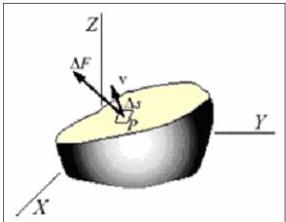
A{'text': '6 — diagonal: σ_11, σ_22, σ_33 (normal); off-diagonal: σ_12, σ_13, σ_23 (shear, with σ_ji equal)', 'label': 'B'}
B{'text': '9', 'label': 'C'}
C{'text': '3', 'label': 'A'}
D{'text': '21', 'label': 'D'}
Answer & Solution
Correct answer: A. {'text': '6 — diagonal: σ_11, σ_22, σ_33 (normal); off-diagonal: σ_12, σ_13, σ_23 (shear, with σ_ji equal)', 'label': 'B'}
9 entries in 3×3; symmetry σ_ij = σ_ji removes 3 ⇒ 6 distinct. Three normal stresses on the cube faces, three independent shear stresses (each appearing on two perpendicular faces equally).
Related questions
In Voigt (engineering) NOTATION, the contracted 6×1 stress vector is typically ordered as:An incompressible isotropic material has Poisson's ratio:For an isotropic material, the shear modulus G is related to E and ν by:Hooke's law in STIFFNESS form is σ = C·ε. In COMPLIANCE form: ε = S·σ. The relationship beIn stress/strain analysis, COMPATIBILITY CONDITIONS ensure that:How many INDEPENDENT elastic constants does a GENERAL ANISOTROPIC linear-elastic material How many INDEPENDENT elastic constants describe a TRANSVERSELY ISOTROPIC material (one preHow many INDEPENDENT elastic constants describe an ORTHOTROPIC material (three mutually pe