Home › AP Intermediate 2nd Year › Current Electricity › A circuit contains a single loop with one source…
A circuit contains a single loop with one source and several elements as shown. Why does the sum of the listed drops $V_1$ through $V_7$ equal the source voltage $V_s$? 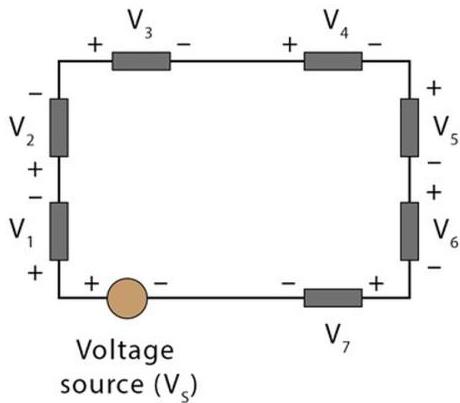
ABecause current is the same everywhere in all circuits
BBecause the source creates charge at a rate equal to voltage drops
CBecause energy gained by a charge from the source is exactly lost across the elements in one complete loop
DBecause resistances in a loop always add to zero
Answer & Solution
Correct answer: C. Because energy gained by a charge from the source is exactly lost across the elements in one complete loop
In one complete traversal of the loop, a charge gains energy from the source and then loses that same energy across the circuit elements. Conservation of energy gives $V_s=V_1+V_2+V_3+V_4+V_5+V_6+V_7$. Option A is too broad, and B and D are physically incorrect.

Related questions
The reactance of a capacitor $C$ at frequency $f$ in an a.c. circuit is:A bird perched on a single high voltage wire is unharmed because:The two conservation laws embodied in Kirchhoff's rules are conservation of:The resistance offered by the cell itself is called:Which device detects the current in a Wheatstone bridge?In a Wheatstone bridge, the source is connected across the:The Wheatstone bridge is made up of how many resistors?At a junction, the current entering equals the current: