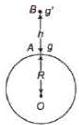
 The acceleration due to gravity at height $h$ above the Earth's surface (where $R$ is Earth's radius) is given by:
A$g' = g \left(1 + \dfrac{h}{R}\right)^2$
B$g' = \dfrac{g}{\left(1 + \dfrac{h}{R}\right)^2}$
C$g' = g \left(1 - \dfrac{h}{R}\right)$
D$g' = g \cdot h$
Answer & Solution
Correct answer: B. $g' = \dfrac{g}{\left(1 + \dfrac{h}{R}\right)^2}$
Newton's law of gravitation at distance $(R + h)$ from Earth's centre: $g' = \dfrac{GM}{(R + h)^2} = \dfrac{GM}{R^2 (1 + h/R)^2} = \dfrac{g}{(1 + h/R)^2}$.
$g$ decreases as $h$ increases. For $h \ll R$ (e.g. mountains, buildings), the binomial approximation gives $g' \approx g(1 - 2h/R)$ — close to option C but with a factor of 2.
Below surface (depth $d$): $g' = g(1 - d/R)$, which does match option C up to a sign — easy to confuse the two.
Related questions
Tycho Brahe recorded his observations using:Kepler's three laws describe the motion of:The low escape speed of the moon explains why it has no:The moon's escape speed compared with the earth's is smaller by about:The escape speed for the moon works out to about:The law of periods uses which measurement of the ellipse?By the law of periods, the square of the period is proportional to:The law of areas explains why a planet moves slower when it is: