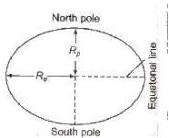
 The value of acceleration due to gravity $g$ on the Earth's surface is:
AEqual at poles and equator
BMinimum at the poles and maximum at the equator
CMinimum at the equator and maximum at the poles
DAlways the same everywhere on Earth
Answer & Solution
Correct answer: C. Minimum at the equator and maximum at the poles
Two effects combine to make $g$ slightly smaller at the equator than at the poles:
1. **Earth's shape.** Earth is an oblate spheroid; its diameter at the equator is about $42$ km larger than at the poles. Since $g \propto 1/R^2$ and equatorial $R$ is larger, $g$ is smaller there.
2. **Rotation.** Centrifugal effect from spinning reduces apparent gravity, maximally at the equator and zero at the poles.
Typical values: $g_{\text{pole}} \approx 9.83$ m/s², $g_{\text{equator}} \approx 9.78$ m/s². Difference is small but real.
Related questions
Tycho Brahe recorded his observations using:Kepler's three laws describe the motion of:The low escape speed of the moon explains why it has no:The moon's escape speed compared with the earth's is smaller by about:The escape speed for the moon works out to about:The law of periods uses which measurement of the ellipse?By the law of periods, the square of the period is proportional to:The law of areas explains why a planet moves slower when it is: