A block $P$ of mass $m$ is placed on a frictionless horizontal surface. Another block $Q$ of same mass is kept on $P$ and connected to the wall with the help of a spring of spring constant $k$ as shown in the figure. $\mu_{s}$ is the coefficient of friction between $P$ and $Q$. The blocks move together performing SHM of amplitude $A$. The maximum value of the friction force between $P$ and $Q$ is 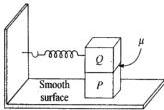
A$kA$
B$\frac{kA}{2}$
CZero
D$\mu_{s}mg$
Answer & Solution
Correct answer: B. $\frac{kA}{2}$
Since the two blocks move together, they behave like a single system of mass $2m$ attached to a spring of constant $k$.
So the angular frequency is
$$\omega = \sqrt{\frac{k}{2m}}$$
In SHM, the maximum acceleration is
$$a_{\max} = \omega^2 A$$
Thus
$$a_{\max} = \frac{k}{2m}A$$
For the upper block $Q$, the only horizontal force is friction. Therefore the friction needed to move it with the common acceleration is maximum when the acceleration is maximum:
$$f_{\max} = m a_{\max}$$
Hence
$$f_{\max} = m \cdot \frac{kA}{2m}$$
$$f_{\max} = \frac{kA}{2}$$
On checking the options, this matches option $\left(B\right)$.
Related questions
The branch describing the motion of a rotating rigid body about a fixed axis is rotationalSix washers on a light rod illustrate the moment of inertia of a system of:The more massive an object is, the more of this it has in linear motion:Unlike linear position measured in metres, angular position is measured in units that are:Acceleration caused by the change in direction of tangential velocity is called:Several torques acting about one axis are combined by finding their:The perpendicular distance from the axis to the line of the force is called the:The SI unit of torque is the newton multiplied by the: