A particle which is constrained to move along the $x$-axis, is subjected to a force in the same direction which varies with the distance $x$ of the particle from the origin as $F(x) = -kx + ax^2$. Here $k$ and $a$ are positive constants. For $x \geq 0$, the functional from of the potential energy $U(x)$ of the particle is
A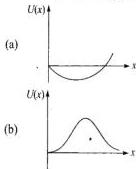
B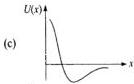
C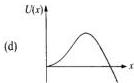
D
Answer & Solution
Correct answer: D.
Since $F(x)=-\frac{dU}{dx}$, we have
$$\frac{dU}{dx}=kx-ax^2$$
Integrating,
$$U(x)=\frac{kx^2}{2}-\frac{ax^3}{3}+C$$
So for $x \geq 0$, the curve starts with zero slope at $x=0$ and
$$\frac{d^2U}{dx^2}=k-2ax$$
Hence at $x=0$, $\frac{d^2U}{dx^2}=k>0$, so the graph is initially concave upward and has a minimum at $x=0$.
Also,
$$\frac{dU}{dx}=x(k-ax)$$
Thus the stationary points are at $x=0$ and $x=\frac{k}{a}$. Further,
$$\frac{d^2U}{dx^2}\bigg|_{x=k/a}=-k<0$$
so $x=\frac{k}{a}$ is a maximum. For large $x$, the term $-\frac{ax^3}{3}$ dominates, so $U(x)$ decreases and becomes negative.
Therefore the graph starts at a minimum at the origin, rises to a maximum, then falls and crosses the axis later. This matches option $D$.
Related questions
The branch describing the motion of a rotating rigid body about a fixed axis is rotationalSix washers on a light rod illustrate the moment of inertia of a system of:The more massive an object is, the more of this it has in linear motion:Unlike linear position measured in metres, angular position is measured in units that are:Acceleration caused by the change in direction of tangential velocity is called:Several torques acting about one axis are combined by finding their:The perpendicular distance from the axis to the line of the force is called the:The SI unit of torque is the newton multiplied by the: