Consider four circuits shown in the figure below. In which circuit power dissipated is greatest (Neglect the internal resistance of the power supply)
A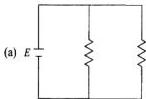
B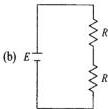
C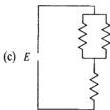
D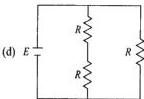
Answer & Solution
Correct answer: A. 
For the same ideal source, total power is $P=\frac{E^2}{R_{\text{eq}}}$. So the circuit with the smallest equivalent resistance dissipates the greatest power.
For option $A$, two resistors $R$ are in parallel.
$$R_{\text{eq}}=\frac{R}{2}$$
For option $B$, two resistors $R$ are in series.
$$R_{\text{eq}}=2R$$
For option $C$, two resistors $R$ are in parallel first, then in series with one more $R$.
$$R_{\text{eq}}=\frac{R}{2}+R=\frac{3R}{2}$$
For option $D$, one branch has two resistors in series and this branch is in parallel with one resistor $R$.
$$R_{\text{eq}}=\frac{(2R)(R)}{2R+R}=\frac{2R}{3}$$
Comparing $\frac{R}{2}, 2R, \frac{3R}{2}, \frac{2R}{3}$, the smallest is $\frac{R}{2}$. Hence the greatest power is in option $A$.
Related questions
The reactance of a capacitor $C$ at frequency $f$ in an a.c. circuit is:A bird perched on a single high voltage wire is unharmed because:The two conservation laws embodied in Kirchhoff's rules are conservation of:The resistance offered by the cell itself is called:Which device detects the current in a Wheatstone bridge?In a Wheatstone bridge, the source is connected across the:The Wheatstone bridge is made up of how many resistors?At a junction, the current entering equals the current: