Find out the value of current through $2\,\Omega$ resistance for the given circuit 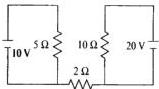
A$5\,\mathrm{A}$
B$2\,\mathrm{A}$
CZero
D$4\,\mathrm{A}$
Answer & Solution
Correct answer: C. Zero
The two vertical resistors of $5\,\Omega$ and $10\,\Omega$ are each connected across ideal sources of $10\,\mathrm{V}$ and $20\,\mathrm{V}$ respectively. In both loops, the resistor is in parallel with its battery, so the potential difference between the top and bottom nodes of the left loop is fixed at $10\,\mathrm{V}$, and for the right loop it is fixed at $20\,\mathrm{V}$.
The top wires of the two loops are not connected to each other, but the bottom nodes are connected through the $2\,\Omega$ resistor. Taking the top nodes as reference through the source polarities shown, the bottom left node and bottom right node come to the same potential relative to their respective top nodes, so the two ends of the $2\,\Omega$ resistor are at equal potential.
Hence the potential difference across the $2\,\Omega$ resistor is $0\,\mathrm{V}$.
Therefore, the current through it is
$$I=\frac{0}{2}=0$$
So the correct option is $\text{Zero}$, which matches option $\mathrm{C}$.
Related questions
The reactance of a capacitor $C$ at frequency $f$ in an a.c. circuit is:A bird perched on a single high voltage wire is unharmed because:The two conservation laws embodied in Kirchhoff's rules are conservation of:The resistance offered by the cell itself is called:Which device detects the current in a Wheatstone bridge?In a Wheatstone bridge, the source is connected across the:The Wheatstone bridge is made up of how many resistors?At a junction, the current entering equals the current: